Wednesday, May 19, 2021

Alfdaín Ascendant


Calidar’s upcoming Series 3
project focuses on the elves. Barring unforeseen production changes, the author is pleased to announce the participation of Thorfinn Tait, master cartographer, and of Jeff Easley tentatively for the cover art. Joseph Garcia will provide internal illustration (b/w inks) and Janet Deaver-Pack line and text editing. Calidar gamebooks are intended for use with mainstream RPGs. As established in the two previous series, the new project will include:

  • A Gazetteer: 132 pages color, PDF format or printed (hardcover or softcover). This book is already written and most of its maps are in their final states as of mid-May 2021.
  • A Players’ Guide: About 24-28 pages, color, PDF format or softcover
  • An Adventure Book: 24-68 pages, color, PDF format or softcover. Final page count will depend on stretch goals during the crowdfunding event. The more backers, the greater the adventure for the same price.
  • Two Conversion Booklets: About 24 pages each, color, PDF format or softcover. They provide all game stats from the previous three titles specifically for use with Labyrinth Lordtm and Osrictm.
Click here for the preview page on Kickstarter, and select the "Remind Me" button near the upper right corner. The launch date will be June 9, at 09:00 am CST.  

The Cal3 Gazetteer

The Queen’s Gift: As with previous releases, this campaign book’s opening chapter is a novelette running 18 pages. It is the third episode of the Star Phoenix adventures, a skyship exploring the Great Caldera. The story is told in the style of the Voyage of the Princess Ark originally published in Dragon Magazine in the 1990s. The Queen’s Gift features a mysterious living skyship.

History: The Gazetteer’s main body goes on to unveil the history of the elves, covering events in their ancestral moon, Alorea, and in the Confederacy of Alfdaín on Calidar itself, a former colony of Alorea. The history tells of a bitter rivalry between the old elven empire and the younger, independent nation.


Geography:
This chapter focuses on Alfdaín, describing the lay of the land, the people, the economy, and the region’s climates. More than 12 full-page maps are featured, including a monumental 9-page atlas based on Thorfinn Tait’s topographical artwork and an overview of Undersea, the world of the sea elves, along with a map of the marine floor.

Riddle of the Woods: A sinister event, care of the old empire’s nefarious machinations, corrupted some of the forests covering Alfdaín. The evil plot lies behind this magical plague, threatening to overtake the whole of the confederacy. Each tainted region’s effects receive a detailed description.


The Law and the Sword:
Alfdaín features an alliance of three sovereign realms. Who holds the power in each dominion, how they interact with each other, what armed forces they possess, how the traditional clans work, and what laws are in effect comes through in these pages.

Behind the Curtains: Discover the guilds, brotherhoods, and secret societies in Alorea and Alfdaín. They are the tools behind Alorean schemes and Alfdaín’s survival. Whether player characters will tangle with them is less a question of when but rather how, and on whose behalf.


Elves of Calidar:
The looks of five elven races, their motivations, styles, and game-related abilities receive meticulous treatments. The Sherandol are forest elves. Staunch defenders of freedom, they favor traditional clans. They dominate in much of Alfdaín. Their allies, the Elëan, favor mountains, relying on their wings to travel quickly. The Meruín dwell on the coasts and below the sea. Their troubles come from a mysterious menace in the marine depths against which they dispatched the Knights of the Rising Tide. The Tolarin are dark-skinned shadow dwellers, strong in magic. The Sòldor, as pale as their Tolarin allies are dark, bear a martial demeanor. They build great cities and, on Alorea, form an arrogant and merciless ruling class.


City of Mythuin:
The capital city of Alfdaín is featured here, with district-by-district descriptions, as well as significant work on the sewers and other areas below ground. Time/location-sensitive random encounters, mini-adventures, and four pages of maps provide all details needed to grasp the city’s layout and its hidden dynamics.

Work in Progress


Alorea: The old, off-world empire receives its own chapter. Its rulers command all on this moon. A magnificent two-page map shows the moon’s climate zones, biomes, topography, roads, major cities, and their inhabitants’ attitudes toward the Alorean dictatorship.

A Cast of Many: All the key personalities of Alfdaín and a few outer-world figures are described here, along with rules-agnostic game stats. This who’s-who catalog weaves a tangled web of clan intrigues, realm politics, and the schemes of secret societies.

Beasties in the Wilds: One does not have a worthy campaign setting without a few more fun monsters to amuse, annoy, or scare players with. On the menu: the abyssal dread and its ixthyan minions dead set on giving nightmares to the Knights of the Rising Tide, plus a smattering of colorful critters such as the forest elderkin, the lurker below, the seamera, and the sturmgänger.

All Hands on Deck: The final section gives an overview of the various skyships involved in this setting, along with their game stats. Five more pages of deck plans describe an elven flying vessel featured in the opening chapter, The Queen’s Gift, including profile and cutaway side views.


Upcoming Event

            Alfdaín Ascendant’s Kickstarter event should take place in 2021’s late spring or early summer. Keep an ear to the ground for news on DTRPG and in other places. For more up-to-date information on this project, revisit this blog or the World of Calidar’s chat groups on Facebook or Mewe.

PG3 Players’ Guide: This handbook will become available for fulfillment simultaneously with its core Gazetteer. Part of it is already written. Pg3 focuses on helping players roll up characters. It also provides new character classes and a travel guide revealing to players what they should know about the campaign setting. The page count isn’t yet established, so it may run longer than estimated here.

CA3 Adventures in Alfdain: (Work title only). Writing will begin after the crowdfunding session ends. Stretch goals directly impact its final page count, starting at 24. The previous series’ adventure book ended up with 68 pages, entirely for the benefit of those pledges that offered this booklet as a reward. Ca3 may include several short adventures or one single one. Final contents remain to be determined.

CAL3a and b: These two booklets will be completed after Ca3. Game stat conversions and interpretations of concepts put forth in Series 3 books are given here for the Labyrinth Lordtm and Osrictm game mechanics. The page count is likely 24 pages or more. One or both of these booklets are included as PDF rewards for the applicable pledges.

Other Rewards: Major maps and deck plans may also be available in digital form as backers’ rewards. Depending on pledge levels, these maps include one, some, or all of the following: the complete Atlas of Alfdaín, the lunar map of Alorea, street and sewer maps of Mythuín, as well as deck maps and side views of the elven skyship featured in The Queen’s Gift story.


Update

So far, the project is doing great!
It almost funded in less than 24 hours, with 28 more days to go!


Monday, May 17, 2021

Updated Halfling Class (OSR D&D-BECMI)

The next character class on my update list is the halfling. The experimental version I'd posted back in February was a bit controversial. Most readers liked the burglar skills. On the other hand, opinions were fairly divided about druidic spellcasting. OK, that was over the top. The good news: there’s plenty of room for options!

Art Credit: "Gemma Sandydowns, Halfling Rogue" by Smolin on Deviantart

Background: This is part of an ongoing series of articles about level progression mechanics. It all started with experimental updates to the magic-user and cleric spellcasting tables posted last January. A number of updated or new character classes followed. Feedback on those was useful—thank you! Suggestions will be incorporated in later updates wherever practical. This led me to create a user-friendly Excel spreadsheet to help put numbers together quickly and easily. This spreadsheet is particularly useful in making sense of the math used when creating homebrew character classes, and in ensuring some degree of consistency across the board. Click here for info on updated saving throws.

The Updated Halfling


1. The experimental version without spellcasting ends up with 2,200 base xp. I added +200 xp as a discretionary modifier to account for the halfling using the fighter combat table and possessing burglar skills (no backstab though, remember?) The burglar skills are those from the original article. Special and racial skills as well as unique class abilities are largely the ones from the official version (I use the RC description). It’s a fairly tough character, given it also has great saves. I set the flat rate above level 9 to +120,000 xp per level. Enjoy!


2. Now, for the spellcaster version, I had opted for a druid rather than a cleric. Feel free to swap druid abilities for those of the cleric if you prefer (there will be a small difference in the base xp). A number of things change from the halfling burglar (don’t be like me and misread this as “halfling burger.”) Aside from the spellcasting ability, unique class abilities drops to minor, weapons permitted drops to few, and armor permitted drops to some. This results in exactly the same 2,200 base xp as the halfling burglar. How convenient. The druid class, as described in the RC, shows no actual special or class-related ability.

If you prefer a druid with special abilities, use those from AD&D as inspiration. I would then move unique class abilities to significant. Abilities at first level include passing through overgrown areas without penalty or without leaving a trail, and identifying pure water as well as plant and animal types. In the AD&D sphere, significant abilities come into play at xp level 7. At this level an AD&D druid can cast one level 4 spell, which corresponds to a level 9 halfling; therefore, these special abilities become available at that level instead. This includes shapechanging and immunity from faerie charms. As a result, this halfling druid with special abilities has 2,300 base xp. I would also up the flat rate above level 9 to +150,000 xp per level because of the way the table adds up.

There you go! Plenty of options to play with.

Monday, May 10, 2021

Updated Thief Class (OSR D&D-BECMI)

The next item on my list is the aforementioned character class. The thief is mostly an open-and-shut case as regards its “revised” xp progression. This being said, I'll take instead the opportunity to present a fun option as a side dish. Click here for the previous article about the updated elf if you need to go back. 

Art Credit:  "Thief"  by jpeabody on Deviantart

Background: This is part of an ongoing series of articles about level progression mechanics. It all started with experimental updates to the magic-user and cleric spellcasting tables posted last January. A number of updated or new character classes followed. Feedback on those was useful—thank you! Suggestions will be incorporated in later updates wherever practical. This led me to create a user-friendly Excel spreadsheet to help put numbers together quickly and easily. This spreadsheet is particularly useful in making sense of the math used when creating homebrew character classes, and in ensuring some degree of consistency across the board.

The Updated Thief

It turns out the base xp generated from the spreadsheet essentially match the official ones. The level progression table is therefore the same. The biggest change came from thieving skills getting boosted at low levels in the earlier article, and from some thinking about backstabbing. Everyone seemed satisfied with these alterations. No change here. I’ll just post the list of choices from the spreadsheet for reference.

What About a Cleric-Thief? Just for giggles, I ran numbers for a spellcasting thief. What's different: I gave the base thief class some clerical spells, cleric saving throws, and the Turning ability. Spells are limited to level 5, with a much slower progression compared with the true cleric’s spellcasting abilities: the thief-cleric gets its first level 5 spell at xp level 14, versus xp level 10 for the official cleric. Spellcasting at low levels is otherwise the same. The other thief class features remain the same (use the updated thieving skills I presented in the previous article).


Base xp grow from 1,200 to 1,800. I manually increased the
base xp with a +100 xp discretionary modifier for the cleric’s Turning Undead since I didn’t think it warranted boosting the thief’s unique class abilities from Significant to Major. I also increased the number of xp required above level 9 from the thief’s 120,000/level to 130,000/level. It seemed only fair. The thief-cleric, therefore, becomes a Custom Class.

            Here is the string of numbers I entered into the spreadsheet.

                1-2-3-3-1-3-1-4-3-2

The updated advancement table for the thief-cleric is as follows:


Monday, May 3, 2021

Updated Elf Class (OSR D&D-BECMI)


Well now, since I have this handy-dandy tool to calculate character class experience levels, it’s time to go back and update the ones I posted earlier.

Art Credit: Elven City Landscape by Ravensey Travis Lacey on Deviantart

Let’s start with the elf.

I had originally guesstimated the xp needed to reach level 2 to be 3,000 (down from 4,000 in the classic rules) in line with my original goal to ease requirements for low level pcs. Here’s the formula I just used on the Excel tool:

If spells are limited to level 6, then 3,100 xp seems appropriate. If you absolutely insist on counting the "extra" 50 xp, enter +50 in the discretionary modifier box, otherwise base xp are rounded down. If spells go all the way to level 9 as I had it in the original article, then the Excel tool points to 4,100.

Given that the classic elf character in the original rules is limited to level 5 spells, both of the two optional versions are definitely more attractive in the long run. I prefer the “elf-lite” version, with the lower xp load and spells limited to level 6, which definitely helps with level advancement early on. "Design à la carte!"

The above stats could be abbreviated as follows:

bhd 2, ct 3, st 3, cs 1, mus 3, uca 1, ra 3, ss 4, wp 4 ap 4
or 2-3-3-1-3-1-3-4-4-4.

What About a Cleric? I ran numbers for an elven cleric (a standard cleric plus the elf's racial abilities, but with the elf's saves). With up to spells level 5, the base xp amounts to 1,800. With the full range of spells, then the elven cleric's base xp is about 2,000. You get the idea. Optional Elven Cleric Profile: 2-2-3-3-1-2-3-3-3-4.

What About a Thief? While I'm at it, a standard thief's experience requirement allowing for elven racial abilities and saves amounts to: roll the drums... 1,500 base xp. This is starting to look like AD&D, with the exception that humans and demi-humans with the same character class still have different base xp requirements, since most things are accounted for. In the AD&D game, elven and human thieves use the same advancement table. Want a few magic-user spells to boot? No problem. Add them to the tab and have some fun! Optional Elven Thief Profile: 1-2-3-1-1-3-3-4-3-2.

Here are the updated advancement and saving throws tables for an old-style magic-using/sword-fighting elf.


Thankfully, the Excel tool  doesn’t produce results that go totally nuts. In any case, you can tweak stuff to your heart's content. If you want to copy/paste tables from the spreadsheet, you'll need to "unprotect" the document first. Either restore the protection when you're done or don't save your Excel file before closing. It is safest to use it while its protection is switched on. At worst, you can always download a clean copy.

More in a few days.

Or click here for the Thief's updated level progression.

Thursday, April 22, 2021

D&D BECMI Alternate Experience Levels


W
ith all these character classes popping up, I felt the need to examine whether class features could determine level progressions. So far, a seat-of-the-pants “guesstimation” has been my method. That’s less than ideal. What if the main features of a character class could be rated with numbers, and added up? This would provide a more precise and consistent method of assigning base xp requirements to all character classes across the board. This may be a mere glint in a designer’s eyes.
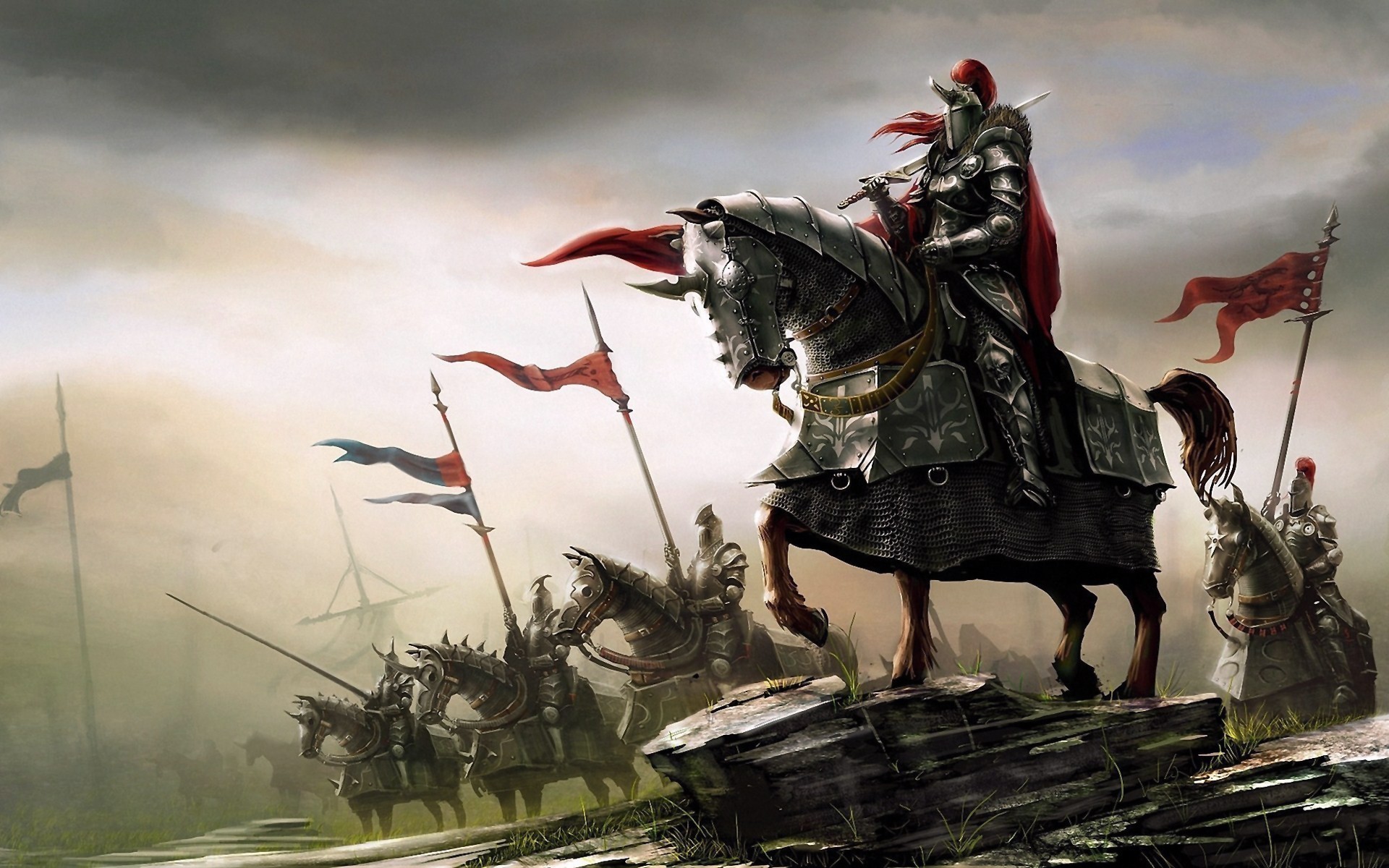
Art Credit: Unknown Author or Copyright

Perplexing Ruminations

While researching the subject, work on exactly the same topic came up in Erin Smale’s fine article Building the Perfect Class. Erin’s system dealt specifically and in great detail with classic BECMI/RC character classes. I wrote my own version, achieving approximately the same results: emulating level progression tables from the classic rules sets. While seeking answers about the origins of the numbers used in official tables, I found they seemed to be based on a combination of educated guesses and subjective empiricism. I don’t mean this as criticism, since I enjoy the game as designed. Nonetheless, as a consequence of emulating official tables, math-based mechanics inevitably manipulate values assigned to character class components, which makes them as arbitrary as their source.

If the end goal is only to emulate official tables, then fine, this matter is settled. On the other side of this coin, however, lies the annoying question: who’s to say that a thief’s 1,200 XP really is a fair amount to reach level 2, compared with a magic-user’s 2,500, or an elf’s 4,000? What logical method is there to decide whether 1,200, 2,500, or 4,000 are too little or too much for their respective class features? This is a thorny issue because rational and consistent calculations involve comparing asymmetrical class components and attributing fair numerical values to each of them. This leads to challenging questions like these: is a d8 base HD more relevant than fighting as a fighter, or than having better saving throws, or than having access to spells? One might assume that being able to cast the full range of magic-user spells is more valuable than cleric spells, but then by what measure—50% more, 100% more, 200% more? How does turning undead compare with backstabbing? How much of this reasoning reflects personal bias vs. objectivity? Assigning values to class components can be subjective if not entirely arbitrary. Thus the conundrum.

Departing from official-but-somewhat-artificial tables, a more-logical system may yield substantially different results. If so, the game may be altered beyond what most fans feel is desirable or practical. What if calculations indicate, for example, that features of a cleric’s character class are more “valuable” than a fighter’s? Out of fairness and logic therefore, experience points clerics need to level up ought to be higher than those of fighters. Or is it that in response to the fighter being more popular, deliberately lowering the cleric’s xp scheme encourages players to pick this latter class instead? Would players and DMs be willing to accept far-reaching changes? Are they worth altering the game? Maybe. Maybe not. It’s worth a look though, at least out of curiosity. The point of this is to ensure all character classes are run through the same process with the understanding that if imperfect, it is at least consistent.

The Big Walkthrough

Perhaps the simplest approach is a walk through the Excel document I created. Always “allow editing” if the notice comes up to make sure you can alter cell contents and to enable the drop-down menus. To maximize your screen "real estate," collapse the ribbon and switch off things like the formula bar, headings, and gridlines. Does not work with software other than Excel.

Click here for the Excel tool.

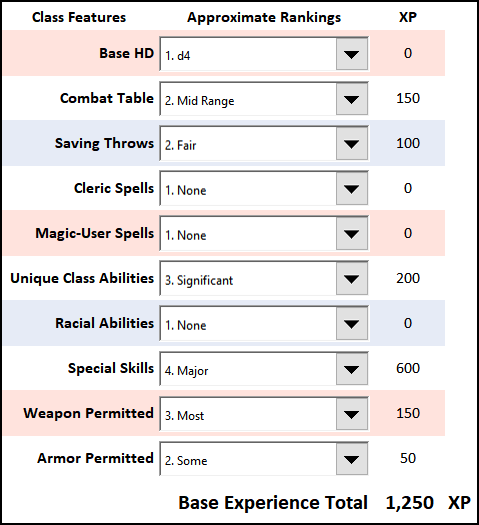
In the upper left you’ll see a section labeled D&D BECMI Class Features and Relative Values. These are subjective xp values I picked for the various class features. Feel free to alter numbers in the gray-shaded cells if you wish. I’d suggest skipping this section altogether for now and trying out the spreadsheet first. Values are weighted so end results fall within the xp range for the revised character classes I posted on Blogspot in the past few months (approx. 1,000 to 4,000 xp). I appended a list at the end of this article. These results are compatible with classic BECMI/RC numbers.

To the right, check the section labeled Class Features–Approximate Rankings–XP, with a series of dropdown menus for each of the class features. Select the most appropriate choice for each. This is a tricky process, because it won’t be clear at first which choice best describes each feature. I’ll clarify each entry in the list below.


Base HD: This one is pretty simple—d4, d6, or d8. In general, the weakest choice gets a “0 xp” rating. The strongest choice gets a ranking many times higher than the previous ones in order to be more relevant in the long run. So, d4 gets “a big, fat zero,” d6 gets a 150 xp, and d8 a whopping 400 xp.

Combat Table: Whether your character fights as a magic user, a fighter, or something else (listed as “Mid Range.”) Same deal. Next…

Saving Throws: This is based on my “revised” saving throws. Click here for this article if you need a refresher. I’m sure you’re getting the point by now.

Cleric Spells: If your character can cast cleric spells, pick the right description. Full Range is for classic clerics. Most Spells applies to classes that cast fewer spells up to level 5. Few spells relates to classes able to cast spells up to level 3. The latter two imply a slower spell progression and possibly certain categories of spells disallowed. I kept this vague because there’s no good way to quantify every possible variation in a simple and manageable manner—hence the end result being qualified as “ballpark.” Pick the best fit.

Magic-User Spells: Pretty much as above. Full Range is for classic magic-users. Most Spells applies to classes that can cast fewer spells up to level 6. Few spells relates to classes able to cast spells up to level 3. Pick the best fit. I’ve assigned 2,000 xp to the full range, but feel free to change this value to 2,500 if you really want to emulate classic game stats. Magic-users are pretty powerful at high levels, so their spellcasting up to spell level 9 rates at least 2,000 xp versus cleric spellcasting up to spell level 7 only fetching 600 xp. It's debatable for sure.

Unique Class Abilities: This includes unique or rare abilities, such as turning undead, reading/casting magic from scrolls, and backstabbing. Minor applies to classes with a single ability used occasionally. If there are multiple abilities certain to be used frequently, select Major, such as a mystic’s abilities. Significant offers an intermediary option if the other two don’t fit.

Racial Abilities:  The approach is similar to the above. Use Significant for demi-human classes in general—things like resistance to dragon breath, combat bonuses vs. giant, etc. In the case of the half-orc, I’d select Major, given the number of abilities and the likelihood they’d be used in most combat encounters.

Special Skills: These abilities relate to skills, such as thieving skills, combat maneuvers, weapon proficiencies, weapon mastery, etc. Same idea as above. Thieving skills and fighter combat skills qualify as Major. Be careful not to duplicate abilities already listed in previous entries. If you create a cross fighter/thief class, adjust the base xp by about +200 to fully account for the fighter skills over and above those of a thief; use the discretionary modifier box for this (see the next section).

Weapons Permitted: That’s pretty clear. Few describes a magic-user. Most applies to dwarves, halflings, clerics, or thieves. All relates to mystics, elves, and fighters.

Armor Permitted: As above. Few would describe a thief. Most relates to the problem with oversized or undersized character races—no actual restrictions exist but size becomes an issue. All applies to elves, clerics, and fighters.

Once you’ve gone through this selection process, you can see the ballpark xp total to reach level 2. Scroll down a bit and look on the left.

Type of Advancement–Level Progression Table: You can see what your character’s level progression should be, based on your previous choices. Select the type of advancement that you want. The first three settings emulate classic level progressions. If you prefer some other custom scheme, select the last option. If you do, be sure to enter under “Alternate Intervals” how many xp each level requires above level 9 (the red box). You can also tweak results to increase or decrease base xp needed at level 2, using a discretionary modifier (the yellow box).

Saving Throw Parameters: Shift to the section on the right of the xp chart. This relates to my revised saving throws (see ref. earlier). Select your character class from the first dropdown menu at the top. Unless you’re designing a custom character class, skip to the next paragraph. Otherwise, pick the last option at the bottom of the dropdown menu: “11. Custom Class.” You then need to select options from the next four dropdown menus below.


Saving Throws Table: When done, follow the big blue arrow to the right. Your character’s saving throws are listed there. By now, you’re done with critical features of your character class. It’s also a useful tool for someone like me, to create alternate character classes using the same basis across the board—as promised!


I included a few extra bits at the bottom of the spreadsheet.

Min/Max Hit Points: If you need a quick reference on hit points for your character, check the section just below the saving throws chart. You’ll need to select the character level and whatever Constitution bonus it may have. If you selected “Custom Class” in the saving throws section, then you’ll need to specify how many hit points your character earns above level 9.

Monster XP–Character Level Conversions: Those are self-explanatory. The conversion system is a very simple one just to give you a quick-and-dirty answer.

Do not bother with “Miscellaneous Criteria” if you find them: stay on the Main Page. The criteria section is just a bunch of reference material needed for the dropdown menus and Excel formulas to work. Ideally, I should review all of my previous character class designs, incorporate feedback I ran across, and update their xp totals according to the system presented here. For reference, here are links to relevant articles posted previously:

Other character classes were introduced in Calidar books:

            Re. these last three: Stats for Labyrinth Lord are also available in CAL1a Conversion Guide to Meryath and CAL2a Conversion Guide to Caldwen. 

Thursday, April 15, 2021

D&D BECMI "Revised" Paladin Class

One more “class” of hero can be added to the panoply of “revised” versions I’ve come up in recent past. D&D BECMI’s classic paladin is an extension of the base fighter class, only available from level 9 up. It’s perfectly fine when playing “by the book.” For the sake of variety, however, I’m now offering an alternative available from level 1 for those who don’t want to wait until level 9. Most adventures back in my earlier years of roleplaying often included a paladin in the party. This iconic character proved awesomely beneficial and at the same time equally infuriating to unscrupulous opportunists. Priceless. The subject of paladinhood since then has been covered to death in multiple RPG versions, so there isn’t a whole lot of innovation that can be brought to this table other than my own creative license.

Art Credit: Paladin by ForrestImel on Deviantart, published: Jun 29, 2017 © 2017-2021 ForrestImel

Regarding D&D BECMI
            Be aware that unlike recent game versions, races are treated as classes—thus an “elf” is a class onto itself, and so are the dwarf and the halfling. If you are a big fan of 5e, that’s great but this article isn’t meant for you, let alone the paladin’s existing treatment in 5e. Comparisons and personal judgements on the nature of games from the early 80s are irrelevant here and unwelcome. Please consider this analogy: plenty of folks love the latest car makes, with the best modern technology can offer; others collect vintage cars as a hobby. Neither is wrong. D&D BECMI also fits on the vintage side of things, much like most other OSR fares.

Origins
            "Paladin" derives from the Latin palatium (a palace), palatius relating to a high-level official attached to an imperial or royal court, a palace warrior. In literature, this eventually referred to a pious knight, as in King Arthur's Knights of the Round Table. In roleplaying games, it became more of a holy warrior, a well-meaning zealot with extravagant powers and a lordly demeanor. Cool. I dig this.

Concepts
            The basis for the paladin is essentially a cross between cleric and fighter, with fancy chrome, whitewalls, and gnarly tail fins. Although I hadn’t intended to grab everything I found in other RPGs about paladins and jam it all into this character class, I carried over the abilities described in D&D BECMI at least. Following the general trend of my recent articles, I focused on the lower levels offering plenty of features to have fun with. I’m using the cleric’s revised spell progression as the basis for the paladin’s spellcasting ability, and the updated saving throws I introduced in the previous article. I added a couple of new things. They replace the +2 bonus to saving throws and miscellaneous combat bonuses, although perhaps with a bit more panache. I’ve also altered mechanics for some of the class features taken from sources other than BECMI.
            Experience point requirements are much higher than the classic fighter’s, given all the special abilities. If you still think the paladin is just too unbalanced for conventional level 1 adventuring, you can start the new character as a level 1 fighter. When reaching 1,400 xp (at the DM's discretion), the fighter makes its oath and becomes a level 1 paladin (with 0 xp).

The New “Revised” Paladin Class

Prime Requites: Strength and Charisma.

Experience Bonus: I give a +5% if Str and Cha average out between 11 and 12, and +10% if they average less than 11, implying that all other stats are lower than the prime requisites. Paladins with lousy stats are possible provided their two best scores go toward Str and Cha. What matters is what truly lies in their hearts (think of Capt. America before his transformation or Don Quixote). At 13+, stats otherwise provide conventional bonuses, other than extra xps.

Hit Dice: 1d8 per level up to level 9, +2 hp per level thereafter, and Con adjustments no longer apply.

Maximum Level: 36.

General Abilities: Fights and saves as a fighter.

Armor & Weapons: All armors permitted. Ranged weapons, however, are restricted since they are deemed a coward's means.

Fighter Combat Options: As fighter; starts with the same number of weapon proficiencies and special combat maneuvers.

Special Abilities: See below.


The Oath: The paladin must of course pronounce its oath of fealty to a lawful cleric order. All RPGs and fantasy settings have their own versions, so there isn’t much point is belaboring this issue here. The bottom line is that there can be no paladin without an obligation to do Good. Failure to comply results in forfeiting all class abilities; the paladin becomes a regular fighter of the same level until proper atonement is performed. Whenever the atonement is complete, paladinhood is regained on the basis of the fighter’s current xp. For example: A level 6 paladin (48,000 xp) demoted to a simple fighter (with 32,000 xp), would regain paladinhood on the basis of the fighter’s current xp, probably becoming a level 5 paladin. This loss can be much steeper at high level.

Alignment Issues: Starting out as “Lawful” is a game requirement. Situations may arise where alignment has changed for no fault of the hero’s. Paladinhood isn’t necessarily lost instantly, provided the paladin never performs malevolent acts. Scrupulously following one’s oath may suffice over time for the paladin to become “Lawful” again, without penalty. The oath therefore safeguards not only those deserving protection, but also the paladin itself. Changing to a “Chaotic” alignment outright (or an evil one in other game versions) will, however, cause the loss of paladinhood, as explained earlier.

Wealth and Hirelings: Paladins do not retain wealth, as pledged in their oaths. They keep what is needed to purchase or replace personal equipment and pursue their missions. The balance of their earnings goes to support their clerical order. They may not forego (in favor of other party members) portions of their treasure shares that should go to their orders. A paladin does not keep henchmen, but may employ hirelings whose combined HD aren’t more than ⅓ their employer’s (rounded down).


Aura of Protection:
This is an ability unavailable to classic BECMI paladins. An aura 15’ radius surrounds the paladin. All evil creatures within range suffer a –1 penalty to hit rolls and saving throws. This aura cannot be dispelled. Affected creatures can sense where this aura comes from.

Detect Evil: This ability is akin to the detect evil spell, thus with a 120’ range. The paladin must be able to see the source of evil.

Laying on Hands: D&D BECMI doesn’t offer this power. I include it here since it is ubiquitous in other game versions. The healing amounts to 4 hit point plus the paladin’s experience level, thus 5 hp at first level up to 40 at level 36. If a wound requires less healing than what the paladin can offer, the balance can be bestowed upon another wounded companion. Once the paladin has used up all of its healing power, this ability is no longer available for the remainder of the day.
             If its healing ability is completely depleted, the paladin still has the option of forfeiting its own hit points in order to heal someone else (also see Knightly Fervor, later). It is considered a feat of great compassion. The player decides how many hit points to spend, up to the recipient’s normal total (the paladin can sense how much healing is needed to revive someone, relative to its own life force). Forfeited hit points cannot be healed for the remainder of the day.
             Malevolent recipients (NPCs or monsters) revived after having been knocked unconscious and restored to their full hit points, must save vs. spell (aimed magic) or change their alignments one notch toward the paladin’s. Saving throws receive a penalty equal to the paladin’s Cha bonus plus ½ the hit points needed to revive the recipient (rounded down; a natural score of “20” always saves). The hero must protect recipients failing their saving throws, or at least allow them to leave unharmed. The alignment change is canceled if the paladin or its companions harm or act against the recipient’s best interest.

Fortitude: This manifestation of faith provides immunity to non-magical diseases. Immunity does not extend to curses such as lycanthropy or a mummy’s rotting disease.

Turn Undead: The paladin can repel undead as a cleric one third its level (rounded down). Therefore, a level 3 paladin turns undead as a level 1 cleric.

Knightly Fervor: A paladin sacrificing its own hit points while laying hands on a wounded being earns faith points equal to the forfeited hit points. Faith points are only gained when forgoing at least 5 hp (or 10% of its normal total, whichever is greatest). A paladin may not accumulate faith points exceeding half its own normal hit point total (rounded up). They can otherwise be saved for later days.
            Faith points are redeemed as bonuses to hit rolls or saving throws. A player intent on spending its paladin’s faith points must clearly announce the matter before making any die rolls (possibly invoking the divine patron’s name for the sake of roleplay). Faith points are spent if the roll fails, just enough for the roll to succeed. If the paladin does not possess enough, current faith points are wasted although they do prevent a critical failure's catastrophic consequences.

Divine Ardor: Whenever striking down a foe affected by the hero’s aura of protection, the paladin earns a +1 AC bonus until the end of the battle. The foe must have at least half as many HD or levels as the paladin’s and been defeated in hand-to-hand combat (no slaying prisoners or helpless opponents, casting spells, or resorting to ranged means). These bonuses are cumulative; they cannot be dispelled unless the paladin is unconscious or subject to magical fear.

Cure Ailments: When laying hands, the paladin also cures any non-magical disease or non-magical poison. If the recipient doesn’t otherwise bear physical wounds, treat as if healing a 5 hp wound.

Hallowed Steed: At the end of the current adventure when reaching level 7, the paladin senses the need to leave on a personal errand. This journey should lead to a location where the steed awaits. The paladin may have to earn its trust and service. It can be a war horse or some other creature best fitting the paladin’s style, at the DM’s discretion. The steed should have +4 hit point but not more than half the paladin’s HD (up to 11 HD, rounded up). Its Int should be no less than 4, and its alignment Lawful regardless of its breed. The steed is bound to its master. It allows no other rider, unless permitted by its master. The steed also receives +1 HD each time the paladin earns two more, up to 11 HD, after which the steed receives only +1 hp. Should the mount perish at a later time, the paladin will sense another has become available after reaching the next experience level.

Holy Sword: Another classic artifact from other game versions implies the existence of the famed holy avenger. Upon reaching level 10, the paladin receives word of such a sword’s possible location. The paladin must leave on a personal journey to wrest the fabulous weapon from evil hands. The so-called holy avenger acts as a +1 magical sword. However, in a paladin’s hands, it rates as a sword +2/+4 vs. malevolent foes. It also produces a 10’ diameter aura that dispels malevolent or hostile curses and enchantments, cast at the paladin’s experience level. The sword must be unsheathed and held in hand for the latter power to manifest itself.

Death Blow: Whenever reduced to zero hp or less in while in hand-to-hand combat, the paladin is entitled an immediate and final strike against its nemesis (must be a malevolent being). The attack receives a +4 bonus to hit and inflicts the weapon’s normal damage +1 per level of the paladin.

Immunity to Mind-Altering Attacks: The paladin cannot fall victim to such spells as charm, hold, sleep, or magically induced fear. Spells such as confusion, hallucinatory terrain, or feeblemind are only effective if the spellcaster’s experience level is greater than the paladin’s. Immunity does not extend to magical illusions, however.

Aura of Piety: The paladin radiates a force 15’ radius keeping at bay enchanted creatures of a malevolent nature. These monsters include those that can only be hit with magic or that were magically summoned. Affected creatures cannot physically touch the paladin or its companions within the area of effect, but can use projectile weapons, spells, and natural abilities. The aura no longer repels those creatures attacked from within the area of effect (with melee or projectile weapons, with spells, or in any other way).

About Calidar: Paladins have not been mentioned in the World of Calidartm up to this point. They must be either pious followers of a divine patron, or zealots. Nothing prevents DMs from running paladins in that world. Paladins are by design empowered by their patron deities to fight demons. They suffer no penalty against rascals (see CC1, page 216), although weapons +2 or better are required. Archfiends require +3 magical weapons or better, and at least experience level 16 for a demon lord, or level 32 for demon prince. On the extreme end of things, paladins can only ever fight a fully ascended deity if they have earned epic hero status (see CAL1, page 86) and have been personally empowered to do so by their divine patrons.

Tuesday, April 6, 2021

D&D BECMI Alternate Saving Throws Pt. II

 As a follow up to the previous article, here is the complete list of saving throw tables for character classes recently brought up on this blog.


Cheers!