Showing posts with label Beyond the Skies. Show all posts

Tuesday, August 25, 2020

D&D: Sky Warriors of Phrydias

Here's an oldie I originally posted on EN World more than 4 years ago. It's actually part of CC1 Beyond the Skies. I bet a number of people haven't seen this. This excerpt introduces an order of half-elven knights who ride giant eagles. Their base of operation is a circular structure hanging from a gigantic balloon.
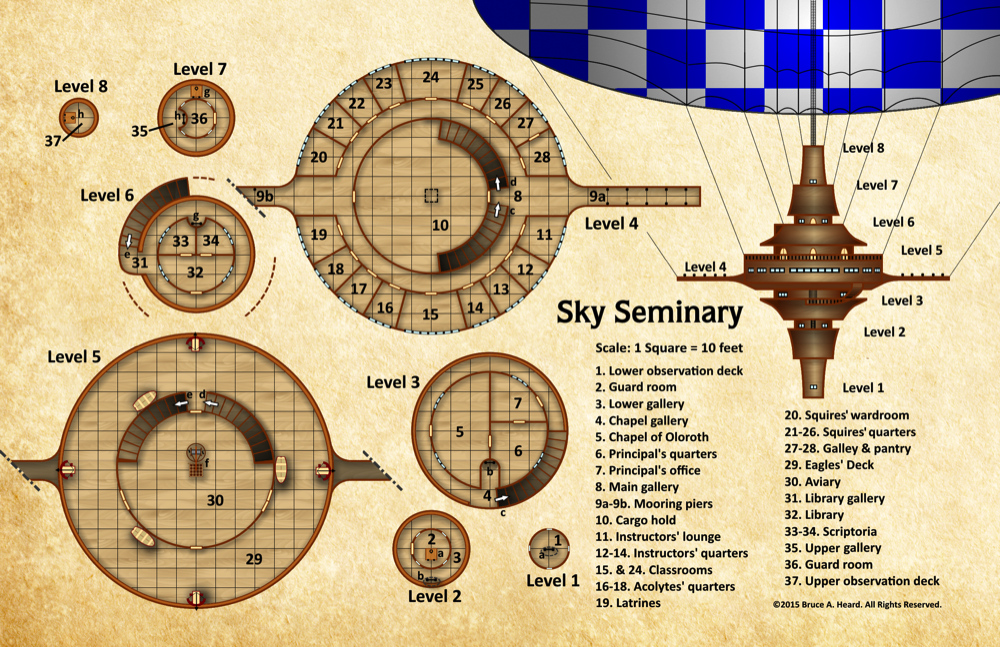
CC1 FLOOR PLAN Phrydias Seminary for EnWorld .png

This order of half-elven knights originally formed in honor of an epic hero by the name of Bambathiel. His legends tell of the first recorded case of a Calderan eagle being tamed as a mount. The giant raptors are reputed for being particularly difficult to approach, let alone to befriend and ride like a horse. Magic sometimes works in this respect, but followers of Thaëldar see this as an insult to their deity. For them, Calderan eagles embody their Lord of the Skies. Being entrusted with one is nothing less than a holy gift requiring utmost respect and devotion.

Bambathiel died in a fight with a night howler, a great beast of evil that had been preying on Calderan eagles in the Kaël Mountains. Though he who became known as the First Knight defeated his mythical foe, his wounds and those of his majestic mount were awash with deadly poison. No prior in Phrydias could stop its spreading, and both died in writhing pain. The High-Prior of Thaëldar prayed for their return to life, but the Great God of the Skies decided to keep them both at his side. Since then, faithful followers of Thaëldar, those who are pure of thought and brave at heart, have created the Order of Sky Warriors in memory of their fallen hero. Bambathiel and Oba Eagle-Lord together became scions of the cult and the order’s spiritual protectors.

The night howler is an enormous beast that sometimes appears late at night. It is born from the nightmares of slumbering evil Phrydians, and vanishes before dawn. What is unclear, however, is why so many people would make the same horrid dream during one fateful night. No Bongorese literature had ever mentioned night howlers. A sect of malevolent wizards or perhaps a demon are thought to be at work, summoning the beast when the moons are right, perhaps as the consequence of an unholy ritual planting seeds of evil into many a weaker or disturbed mind. Priors of Thaëldar have come to believe that in the heart of the eagles lies great spiritual power, which the wicked covet for their evil deeds. What they do with such wondrous power remains a mystery. As the beast unexpectedly rises again to wreak havoc upon Thaëldar’s flock, the knights scramble to deny the odious harvest. In truth, the beast springs from a curse. It was cast by the demon-prince Kokumo, when Thaëldar cast his spear at him.

This order is the armed chapter of the Faith of Thaëldar. Aside from safeguarding breeds of eagles small and large, they live to protect of the Sky God’s temples in Phrydias and elsewhere. A contingent resides in northwestern Alfdaín where the cult has found significant following. Their ethos is neither fundamentally malevolent or purely benevolent. Their philosophy concerns more specifically the order of all things in the universe. Most members of Thaëldar’s fanatical legion stick together as a military organization. Others ride their fabulous mounts, travelling the world in search of clues about who or what lies behind the summoning of night howlers. They are avengers, adventuring warriors looking for a worthy cause for the purpose of acquiring goodwill toward their quest and their faith. Their beneficiaries are to watch for defilers of great eagles and for clues about the night howlers, and alert them if such comes about. Following the belief that evil doers dwell in evil places, sky warriors aren’t loath to exploring dungeons and other places of despair, for hints may lie there was well.

Isn’t a knight anyone who desires it. Prerequisites include being at least a pious follower of Thaëldar. In this regard, race is not an issue. To become a squire, one must already be a fine warrior or a skilled prior (one with the experience of at least a dozen worthwhile dungeon expeditions should qualify). A time will come when the squire will have to seek out a giant eagle’s nest high in the Kaël Mountains and earn its occupant’s respect, a perilous quest on its own. Magic of any kind, clerical or otherwise, is not permitted, and the squire must act alone. Should a glorious fate shine upon the squire, an egg will be available for the taking. It must be safely returned to the order’s sanctum, wherein its new owner will have to care for it until it hatches. The squire must raise the young eagle, nurture its growth, earn its loyalty, and train it as a mount.

Note: The remainder of the chapter goes on about 
risks and rewards of being a knight, and creating a player-character. You'll find all this in CC1 Beyond the Skies

Wednesday, July 1, 2020

D&D: The Horror Below

            The Teekal were native fellfolk who turned into jellyfish-like wraiths. Eons earlier, these stone-age nomads dwelled along Grand Valley of Khargandal’s southern shores. They dabbled with dark magic Ghülean raiders left behind for them to unearth. While the Teekal learned much in the necromantic arts, their newfound knowledge slowly transformed them into their present form: translucent and devoid of bones, fundamentally evil, undead, and craving the vitality of the living. Their arid homeland and the scorching light of the tropics drove them to seek the cool dimness of the deep, claiming the Teekal Seaway as their new realm. Save for parietal art hinting at the fellfolk’s sinister fate, little remains of their past existence on land. They are now irretrievably beholden to alien gods of Ghüle whose emissary they await. 

Skull Jellyfish by Manzanedo ©2020 Manzanedo
            Those intruding upon the seaway’s depths will probably encounter the Teekal’s marauders first. These are soulless constructs indistinguishable from large jellyfish. They occasionally foray into nearby seas, in search of prey near the shores of the Taslan Peninsula and the Island of Mareas. They usually attack small boats at night. Their purpose is to fetch what their makers covet the most: the souls and memories of the living. With their long tentacles, they ensnare their quarry and paralyze them. While kept alive and fully conscious by means only necromancers can fathom, their heads are cut off and their bodies discarded. All flesh other than eyes and brain matter is digested, after which the skulls and their contents are sucked into the marauders’ translucent innards and taken back to their makers.
            The Teekal upper bodies appear humanoid, while their lower halves looks more like bell-shaped cnidarians, with whorls of writhing tentacles where legs ought to be. With one such tentacle, one may pierce through a captured head and burrow into its brain in order to examine its owner’s past life. The process may last many days of sheer pain and horror for the victim, as the inquisitor sifts through items of interest and dwells with unholy relish upon emotional moments defining one’s entire life. All memories are meticulously observed, organized, and mentally marked for future use.

            Should captives offer little of interest, their flesh is sucked out and their souls devoured. Marauders regurgitate the bones and return to their previous duties. The others remain in a great hall made from hollowed out skulls, in alcoves where marauders and their captives are kept alive. By then, most victims have gone utterly mad from terror and despair, but such isn’t the Teekal’s concern. Their intent is to preserve all the information they gathered and turn it over to the Ghülean emissary, should it ever show up.

Marauder: Body AC 9/tentacles AC 6, HD 4**, 15 hp +1/tentacle, MV 30 (10’), AT 1d4+1 tentacles, D 1d4 each, Save F8, Int 0, ML 12, AL Chaotic, Size: M, XP 175.
            Abilities: Invisible from more than 30’ unless holding a skull. Paralysis as a ghoul. It fights with up to 5 of its fifteen 30’ long tentacles each round. Each hit requires a saving throw. The marauder wraps 1d4+4 tentacles around a paralyzed victim and floats away, fending off any pursuers with 1d4+1 of its remaining tentacles. Unless rescue takes place, the victim’s head is sucked in and extraneous flesh and hair melted off within the next 3 combat rounds +1 per experience level or HD of the victim. Death occurs if the disembodied head is taken from the marauder or if the creature is slain.
            Each tentacle requires at least 1 hp damage to cut off. They are immune to blunt and piercing/stabbing weapons, except for their magical bonuses, if any. The marauder’s bell-shaped body incurs half damage from slashing and blunt weapons except for their magical bonuses. It suffers normal damage from piercing/stabbing* weapons and magical attacks (* includes most swords if their owners clearly announce they are stabbing only). The creature uses tentacles with which it performs attacks to keep these foes away from its body. It receives a +2 bonus to hit foes ignoring tentacle attacks in order to reach its body. Tentacles can strike foes up to 30’ away. Inflicting 15 hp of damage to the body kills the creature. Marauders suffer an immediate Morale Check with a –2 penalty during each round of exposure to sunlight.

Jellyfish Mermaid by Castaguer
© 2015 - 2020 Castaguer93
Teekal*: Body AC 7/tentacles AC 4, HD 7*****, 32 hp +6/tentacle, MV 60 (20’), AT 4 tentacles or 1 spear or 1 spell, D tentacles and spear 1d6 each or by spell, Save F10, Int 10+2d4, ML 7, AL Chaotic, Size: S (fellfolk body size), XP 2,450.
            Abilities: Spellcasting as level 6 clerics—spell levels I-II x2 each, level III x1. Same general abilities as the marauder (they do not carry their foes' skulls). Teekals attack with all four of their 20’ long main tentacles; they require 6 hp damage to sever although they regenerate within a day. Their bodies can withstand up to 32 hp.
            They possess two arms as part of their torsos, although their hands and fingers are worm like. Some may wield a long spear whose head was coated with poison. The toxin is discharged with the first successful attack, liquefying the foe’s internal organs for 6d6 damage (save for half).
            Teekal speak a more sophisticated version of their old language, which other creatures in the region may understand (such as the Hanāi published earlier). They developed a written form, and can produce magical items.

Samaz Symbol
An Unexpected Guest: A sea god of Caldwen, Samaz is in fact a renegade who fled his alien masters in the Ghülean dimension. Powerful in his own right, he rose as a deity, hiding his true origins and watching for portents of his former overlords coming into Calidar’s universe. He’s found the Teekal and knows their purpose. Working surreptitiously from the shadows, he endeavors to manipulate their race, occasionally posing as a Ghülean emissary when the Teekal commune for their spells, hopefully to divert them from their evil quest. Some may already be under his sway. Ghülean gods have not detected his influence so far. Nonetheless, Samaz posted aquatic servants of his at narrow straits outside the Teekal Seeway and the Sea of Daor. Their objective is to slay marauders attempting to cross through, and launch an invasion should a Ghülean emissary show up. These forces often rely on beguiled sharks, swordfish, sea turtles, which are natural jellyfish predators.

Source: The map was cropped and altered from the revised climate chart by Thorfinn Tait, available as a poster map on DTRPG ©2019 Bruce A. Heard. Ghüle was introduced in Calidar’s CAL1 In Stranger Skies, page 55. Ghüle and Samaz were developed in CC1 Beyond the Skies, pages 102 and 245. The marauder and the Teekal as fantasy creatures constitute original content ©2020 Bruce A. Heard.

Wednesday, May 27, 2020

Back from the Grave

Since the subject of epic heroes, demons, and gods has been touched upon in this blog, here’s another related aspect that was developed in Calidar’s CC1 “Beyond the Skies:” the incarnates—spirits given a mortal body and a mission to accomplish in the prime plane. This can be easily adapted to D&D BECMI, as agents of immortals.
No information found on image, artist, or copyright.
What Do They Do? Incarnates are usually chosen from the ranks of Divine Servants (see CC1, p. 211). Their objective is to return to the world of mortals, accomplish their missions however long they may take, and return to their liege deities’ spiritual domains. Under this system, a killed PC may very well return as an incarnate for some unfinished business. Incarnates do not age beyond maturity, therefore their quests may last centuries if need be. This is of interest in Calidar since raise dead spells don’t readily work there.

What Do They Look Like? Incarnates may retain their original forms, such as a deceased PC, or take the one of a baby abandoned in the reeds by a river, a diabolically intelligent animal, a monster, a demon, etc. Parents most likely aren’t aware of a child’s supernatural nature. Affected PCs may not remember a thing about their deaths and circumstances that led divine servants or deities to return them to life. Others may not remember anything (other than their skills and abilities) predating their "resurrections," as best fits a DM’s plot. In both cases, clues and dreams will guide them to their final fates. In time, they may piece together who they really are and why they stand among the living. Incarnates are driven to accomplish their quests.

Reviving Dead PCs: Players of dead PCs returning as incarnates would have to correctly roleplay amnesiac adventurers searching for their past histories. Feel free to play fast and loose with time*, as events in the netherworld and the gods’ dimension of Ambrosia conveniently do not have to follow the Prime Plane’s timeline. Another scheme would require the DM to create an entirely new character, one strangely similar to the deceased but with unexplained and possibly frightening abilities appropriate to an incarnate. “You see stumbling toward you this odd character, disheveled and visibly disoriented, muttering incomprehensibly…” Hopefully, the party does not try to kill the poor devil on the spot. They might find it harder than expected. Once past this hurdle, the DM then hands the new character sheet over to the distraught player who just "lost" a beloved character. I’m sure you get the idea.

(*) About Altered Timelines: Time in the astral plane (the netherworld), doesn't flow in a straight course. It can be faster, slower, or even reverse course for a while, compared with the prime plane**. The same can be said about the Ambrosian dimension where gods reside. All of this rests at the referee's discretion. It enables odd story developments where PCs, unaware that their present characters are soon to meet their dooms, run into their own incarnates returned from the future. The plot would have to be entirely premeditated on the referee's side, but nonetheless possible. What happens next is anyone's guess. Imagine a PC meeting a mysterious, hooded incarnate and discovering it bears the PC's facial traits... A forgotten twin sibling perhaps? A doppelganger? Who knows.

(**) Space Travel: The astral's time warp is a crucial element of space travel aboard Calidaran skyships (see CAL1 "In Stranger Skies" about this). As a result, time travel is possible in this universe, provided the referee sees a need for it. 

Abilities & Peculiarities: For the sake of making them unique among mortals, it may be a good idea to give incarnates immunity to non-magical weapons, or a natural AC that is uncannily good. Incarnates can be slain like any other living being, in which case their spirits return to the liege deities who’d sent them. Undead foes might also hesitate to confront incarnates, perhaps requiring a saving throw. PC incarnates may resume earning experience and leveling up. Two tables follow, which list innate abilities and other oddities called “stigmata” that you could have fun with. Roll or pick one of each.

Incarnates Innate Powers (d20)
1
The incarnate regenerates all physical damage at sunset or sunrise (or with some other specific event, such as a ritual offering, a sacrifice, touching a lake’s or a river’s waters, etc.)
2
A basic ability such as strength, intelligence, constitution, or other, increases just past the very limit of mortal capability.
3
Roll 1d6: 1-2. The incarnate only sustains half damage from spell effects; 3-4. Is immune to non-magical damage; 5-6. Is immune to a form of attack—roll 1d10: 1. Fire; 2. Cold; 3. Water; 4. Earth; 5. Air; 6. Electricity; 7. Poison; 8. Acid; 9-10. Certain weapons (roll 1d6: 1-2. Crushing; 3-4. Piercing; 5-6. Hacking/slashing).
4
The incarnate moves at twice the normal movement rate or is never hampered by vegetal growth, sticky webs, and any other magical effects intended to slow or immobilize.
5
Once per day, the incarnate can transfer some or all damage between creatures within a 15’ radius, including him/herself. The number of creatures receiving damage can never be less than those who suffered the original wounds. Damage is averaged among those receiving the wounds, healing the beneficiary/beneficiaries the same amount. Unwilling participants are allowed a save if death would result.
6
The incarnate radiates a 15’ radius aura of protection repelling incorporeal foes or a type of creature designed by the referee, or the incarnate obtains the loyal services of a monstrous creature, so long as the incarnate does not intentionally harm the creature or makes no effort to protect it.
7
If desirable, the incarnate may (roll 1d6): 1. Rust ferrous objects when touched; 2. Rot organic objects; 3. Wither plants; 4. Summon a crawling mass of bugs; 5. Freeze exposed liquids within 15’ radius and cover surfaces with frost; 6. Cause fear on sight. As an alternative, an incarnate may undo all of the above at will.
8
The incarnate has a 20% chance of resisting mortal magic, either from spells cast directly at the incarnate or from others cast nearby.
9
The incarnate’s attacks, whether inflicted with an open hand or some mundane weapon, are always considered magical in nature and at least sufficient to harm creatures relevant to the quest.
10
When touching a hated foe, the incarnate can (roll 1d4): 1. Drain a foe’s energy (as appropriate to the chosen game system), 2. Reduce a basic ability (strength, constitution, charisma), 3. Cause a disease, 4. Inflict a withering wound. The incarnate can reverse the selected effect, if desired.
11
The incarnate is able to detect lies, illusions, traps, or secret passages.
12
The incarnate can only be harmed with spells and (roll 1d10): 1. Bronze; 2. Copper; 3. Silver; 4. Gold; 5. Obsidian; 6. Ivory; 7. Bone (of a specific creature); 8. Jade; 9. Araldium (mythril); 10. Wooden stake in the heart.
13
If destroyed, the incarnate can rematerialize up to nine times in the world of the living during the next full moon and resumes its assigned quest. Also, roll 1d12 for an additional innate power at each occurrence.
14-18
Roll a d12 twice for two innate powers, ignoring duplicated scores.
19-20
Roll a d12 thrice for three innate powers, ignoring duplicated scores.

Stigmata of the Incarnates
d20
Hallowed Marks (Lawful)
Unholy Stains (Chaotic)
1
The incarnate’s skin is slightly silvery or golden, and never soiled with dirt, blood, or sweat.
Skin appears somewhat scaly or with imperfections (moles or small scars which seem to shift when observed).
2
A lock of the incarnate’s hair glows and flies away as a butterfly when his/her name is spoken.
A lock of the incarnate’s hair grows into a spider and crawls away when his/her name is spoken.
3
When in pain, the incarnate cries tears of (roll 1d4): 1. Blood, 2. Milk, 3. Ink, 4. Ale.
In anger, the incarnate’s eyes turn entirely (roll 1d8): 1-2. White, 3. Green, 4. Blue, 5-6. Red, 7-8. Black.
4
The incarnate’s breath brings small plants and insects back to life.
The incarnate’s breath curdles milk or spoils varnish on furniture.
5
When singing, the incarnate attracts small birds and furry critters which happily tweet and chatter along.
Singing causes small birds and furry critters to (roll 1d6): 1-2. Flee, 3-4. Fight one another, 5-6. Explode in small balls of fur or feathers.
6
Cabalistic writings on the incarnate’s skin seem to change as events unfold.
If squeezed, sickly buboes squirt (1d6): 1. Acid, 2. Spiders, 3. Flies, 4. Worms, 5. Darkness, 6. Miasma.
7
The incarnate radiates a faint golden aura when praying.
A sense of despair pervades a chamber when the incarnate prays.
8
A birthmark or a scar appears on the incarnate’s forehead when in presence of the spiritual patron’s unveiled holy symbol.
9
The incarnate’s body bears one or more small unhealing wounds.
The incarnate’s flesh bears one or more small monstrous faces.
10
The incarnate is unharmed when walking barefoot on embers.
The incarnate can safely swallow nails and broken glass.
11
The incarnate can survive with as little as an ounce of food per day.
The incarnate eats and drinks as much as his/her own weight daily.
12
When the incarnate is introduced to newcomers, everyone involved seems to perceive faint echoes of a heavenly choir for a fleeting but glorious instant.
When the incarnate is introduced to newcomers, everyone involved seems to perceive ominous whispers for a fleeting but disturbing instant.
13
The incarnate walks on all surfaces as if weighing no more than a feather.
The incarnate’s footprints are those of a creature with cloven hooves pointing backward.
14
When gazing into a mirror, a glimpse of the incarnate’s home plane shimmers in the background.
The incarnate produces no mirror reflection.
15-18
Roll a d12+2 twice for two stigmata, ignoring duplicated scores.
19-20
Roll a d12 thrice for three stigmata, ignoring duplicated scores

Aside from PCs trapped in the role of incarnates, here are game stats for an alternative monster version that a party of adventurers could run into.

Incarnate*: AC 2 (1, 0, or –1, unarmored), HD 8+2 (12+3, 16+4, or 20+5), MV 150’ (50’), AT 1 punch or weapon, D punch 1d4+1 (1d6+2, 1d8+3, 1d10+4) or by weapon +1 (+2, +3, +4), Save as Fighter of equivalent level; Size M (6’ tall), Ability Scores 6+3d6 (discard the lowest roll; min Int 13), ML 11, AL as appropriate.
            Abilities: Spellcasting and character class abilities, if any are appropriate. Roll for one Power plus one Stigma of the appropriate kind for each 4 HD. Undead foes need to succeed a saving throw before touching/attacking an incarnate.

Bear in mind of course that rival deities may resort to sending agents of their own to interfere with the incarnate’s mission, if they know what it is, or eliminate the troublesome creature altogether. Incarnates are mere pawns in the gods' eternal games of chess.

Sorry for the messed up tables. They work fine on Chrome but not on some other browsers. You can thanks Google and Microsoft for not getting their digital ducks in row.
Qu*.*ck, qu*.*ck.

Tuesday, May 19, 2020

Gods: From Calidar to Mystara

After the two recent blog articles focused on epic heroes and demigods, I now have to give the “apex spirits” a new look. I’ll endeavor to provide straightforward D&D BECMI stats and guidance on correlating Calidar’s gods with Mystara’s immortals. The original material on cults and patron deities came from CAL1 “In Stranger Skies.” It was hugely expanded in CC1 “Beyond the Skies,” which offers tons of background info, not only on the deities themselves but on the structure of pantheons, who/what dwells in them (beside the obvious), and how this all actually works.

Brimaz, King of Oreskos ©2014-2020 PeteMohrbacher, Deviantart

As regards Calidar, the original concept about gods is that they just don’t interact physically with mortals, therefore actual game stats weren’t provided. CC1’s primary objective was to outline benefits and liabilities to worshipers and clerics especially. This present article addresses instead the game mechanics behind Calidar gods and therefore how they relate to demigods and epic heroes. So, before proceeding further, here is the hard data on game stats.

Gods of Calidar (CC1 p. 211)
Abilities
Minor God
Greater God
Pantheon Ruler
Hit Dice
Base 60 + Adj.* (+50 hp)
Base 70+ Adj.* (+60 hp)
Base 80 + Adj.* (+70 hp)
Size (feet)
15’
Movement:        walking
swimming
flying
240’ (80’)
300’ (100’)
330’ (110’)
270’ (90’)
330’ (110’)
360’ (120’)
300’ (100’)
360’ (120’)
390’ (130’)
Teleport (times/day)
Teleport, teleport other, and planar travel at will
Armor Class (AC)
–10
–15
–20
# of Physical Attacks
Fists x3 or 3 weapon
Physical Damage
Fists: 2d20+12 each,
or by weapon +12
Fists: 4d12+14 each,
or by weapon +16
Fists: 3d20+16 each,
or by weapon +20
Special Abilities
Spells and all special abilities available to clerics Level 36, plus all Divine Favors from the deity’s sphere (see CC1, Table 10). They can shapechange at will, can possess mortals in the same manner demons do, and enjoy doppelganger abilities. They are never surprised by lesser beings than ascended deities, possess telepathic abilities, and can commune with any being except Ghülean gods. They strike first at the beginning of a battle vs. non-divine foes. Gods require neither air, nor food, nor water, nor sleep to live.
Exorcise/Turn Undead
As clerics Level 36
Call Other
Can summon/dismiss at will any being(s) of their faith, such as pious followers, zealots, clerics, epic heroes/villains, divine servants, demigods, demons, or other monstrous beings up to half the gods’ HD.
Regeneration (per hour
Non Divine Dmg.
Divine Damage

60%
25%

70%
30%

80%
35%
Saving Throws
As clerics Level 36
Basic Immunities
Non-magical attacks and any others involving non-divine magic, and all netherworld effects. See Godly Impunity in CC1.
Magic Resistance
Non-Divine Magic
Divine Magic

Immune
15%

Immune
20%

Immune
25%
Min. Int. & Wis.
18+
19+
20+
Alignment/Cha
Prevailing worshipers’ Alignment/Cha 18+
Morale (ML)
11
(*) See Hit Dice later in this article.

Generalities on Calidar Gods

Beside what transpires from just scanning through the stats, Calidar deities have built-in abilities and limitation. First off, they’re not omnipotent. They must focus on something to become aware of it, just like normal people. It’s the reason they use a vast hierarchy of spirit servants to watch, listen, keep records, dispatch cleric spells, and bring up areas of concern with the gods. Here’s a summary of their “executive” abilities:
  • Insight: Gods can detect lies from mortals, and their alignments.
  • Communion: They understand any mortal language and can use telepathy.
  • Divine Might: Common mortals (as opposed to epic heroes), if they ever met an ascended god, would be stricken with awe and be unable to refuse any given order.
  • Travel: They can teleport self and/or others through the planes.
  • Summon: As above—gods can freely summon mortal beings, epic heroes, and demigods of their faith.
  • Godly Impunity: They are essentially immune to all forms of attack from mortals.
  • Veil: They can conceal any non-divine being, object, place, or past event from the consciousness and memories of mortals. Gods acting together can hide entire races and their histories over thousands of years from other gods and even deliberately from themselves (yes, this actually happened).
  • Divine Domains: “Elder” deities are the ones who initially built their pantheons’ hidden pocket planes as their peers’ permanent dwellings. Outsiders only enter if invited in. Ambrosia is the dimension on which all the pantheons’ domains are located; creatures dwelling in its wilds are more than capable of devouring gods.
  • Create Avatars: Gods rarely intervene personally in the affairs of mortals, other than through clerics and epic heroes. An agreement among Calidar’s pantheons called the Ambrosian Covenant strictly limits divine meddling. Nonetheless, should gods personally intervene in the Prime Plane, it is through avatars. Demigods have no such ability, and thus are personally at risk if involved on that plane. The Ambrosian Covenant does not apply to demigods because epic heroes can confront and defeat them. Ghülean gods and living deities of Draconia do not respect the covenant; neither possess the ability to create avatars.
  • Create Extensions: Gods can create alternate identities that are worshiped as separate entities. They involve separate physical forms with their own divine dwellings. In most cases, mortals and deities are unaware of someone else's divine aliases, although conjecture may lead to obvious conclusions (such as Ellyrion's Teos, Narwan's Soltan, and Meryath's Fireking, but not Caldwen's Urthaala or others). 

Ascended gods possess an extravagant number of Hit Dice, compounded by the general size of their mortal flocks in the Prime Plane. Deities possess a base HD (see game stats earlier), which represent magical power they draw from Calidar’s world soul. An adjustment follows, representing the size or fervor of supporting cults among mortals. Demigods do not receive HD adjustments for the number of their mortal followers. For simplicity, the scopes of these cults are ranked A-G, from smallest to largest, as shown in the following list:

Deities’ HD Adjustment
Cult Size
Minor
Greater
a. Tiny
+10
b. Very Small
+10
+20
c. Small
+20
+40
d. Sizeable
+30
+70
e. Large
+40
+100
f. Very Large
+50
+150
g. Huge
+60
+350

For Example: A minor god with a tiny flock has a base 60 HD +0 HD for size = 60 HD (+50 hp) while a greater god with a sizeable flock racks up a base 70 HD +70 HD for size = 140 HD (+60 hp).

Pantheon Rulers: They most likely qualify a greater gods but they also receive additional HD equal to 10% of all deities and demigods in the pantheon (round down).

Estimating the Size of Cults: CC1 provides data on how extensive cults are relative to one another, but unless the exact population figures are known for each region, this info is of limited use from one pantheon to the next. It is a clue nonetheless. Seat-of-pants assessments are needed here, based on CC1’s data and what referees feel works best in their campaigns. Some of the faiths described in CC1 extend beyond the Great Caldera itself, such as those also concerning Calidar's three moons: the elves (Alorea), the dwarves (Kragdûr), and the cults of Teos or Soltan (Munaan). Referees should also feel free to tinker with adjustments from “homebrew” cults, especially if they are unusually lax or fanatical—i.e. a small but fanatical cult might be considered “sizeable” because of the strength of its worshipers' fervor.

Pantheon Examples

Huge: Teos/Soltan—430 HD + 70 hp, or approx. 2,000 hp total.
            Though the above numbers are technically correct according to the suggested method, an exception may be in order for Teos/Soltan, since this cult theoretically outnumbers most of the others, based on descriptions in CAL1 and CC1. I’d shamelessly double the total, at least. I also treated Teos as a pantheon ruler even though it counts no other god, suggesting that the grand old deity is the ruler of just his own august self and his many other identities.
Very Large: Delathien—220 HD + pantheon 130 HD = 350 HD, or approx. 1,285 hp.
Large: Ellorien (170), Faëriad (170)
Sizeable: Adamar (90), Durandil (90), Sphiel (90)
Small: Arëatha (80), Ashebai (80), Maëlrond, Melrenwë (80)
Demigods: Bëlianda (52), Eilonna (52), Mythriel (52)
            The bottom three figures are demigods (paragons—see related article). The total for the pantheon (including Delathien) amounts to: 1,306 HD, therefore Delathien’s pantheon ruler bonus should be 130. In practical terms, the number of hit points or HD is irrelevant aside from giving a good feel for the relative strengths of deities within a pantheon. This makes it possible to compare separate pantheons, enabling a referee to “adjust” the size of cults to balance everything as needed. If you actually decide to run battles between gods, then you’re nuts and you deserve to live in interesting times.

Alliances: There’s an ulterior motive for quantifying divine HD. CC1 describes in a lot of detail internal politics and rivalries among gods of a pantheon. Measuring their relative strengths offers further insight on the stability of a ruler and how willing related gods are to work together. In turn, this directly affects how clerics of a faith behave when confronting another cult. PCs and epic heroes openly backing a deity for all to see could foster interesting plot developments during their adventures.
            Case in point: There are three circles in the elves’ divine pantheon—1. Delathien’s allies, 2. His Rivals, and 3. Nonaligned deities. Delathien’s group racks up a whopping 494 HD. The rivals come next with 392. The neutrals stand last with “only” 250 HD. If the latter all sided with the rivals, Delathien would have a big problem and a conflict might occur… and a possible change in management. Thus do the dynamics of divine politics begin to take shape. Add to this other possible factors (alignments, parental links, individual rivalries, friendships, secret romance, courtships, blackmail, and so on), demonstrating without the shadow of a doubt that the world of gods is no better than that of mortals who created them.
The Mystaran Connection: You might have noticed that the total hit points initially attributed to Teos/Soltan earlier in this article corresponds to the maximum hit points for Hierarchs in “Wrath of the Immortals.” It wasn’t a coincidence. The simple way to “convert” Calidar gods to Mystaran immortals is as follows, ignoring HD altogether:

Gods to Immortals Conversion
Calidar
Mystara
Initiate (demigod)
Initiate
Temporal (demigod)
Temporal
Paragon (demigod)
Celestial
Minor God
Empyreal
Greater God
Eternal
Pantheon Ruler
Hierarch

The more detailed conversion method is otherwise to go by their hit points (see “Wrath of the Immortals” p. 55). Thus, with his 1,285 hp Delathien qualifies as a Hierarch; Ellorien and Faëriad are Eternals; Adamar, Durandil, and Sphiel are mid-level Empyreals; Arëatha, Ashebai, Maëlrond, and Melrenwë are low-level Empyreals; and the three demigods are mid-level Celestials. Close enough. As to Teos/Soltan, just rate him a Major Pain. He actually is one, so there

Other Pantheon Examples
Small: Istra—120 HD + pantheon 65 HD = 185 HD, or approx. 720 hp.
Very Small: Fireking/Teos (100)
Tiny: Akuamakue, Alana, Hakulu, Kaimana, Kanemanu, Koanui, Ululani—60 each.
Demigods: Kahula (40), Makapono (40), Nuaka (52)
            Here, Istra doesn’t even qualify as a Mystaran Hierarch, just an upper-level Eternal using the hit point conversion method. The Fireking is an extension of Teos, an upper-level Empyreal. The other gods and Nuaka are all Celestials. Kahula and Makapono are top-level Temporals. Istra’s alliance amounts to 445 HD. Her rivals tally 280 HD. The nonaligned faction can muster 112 HD on a good day. Istra’s alliance is solid.
Sizeable: Naghilas—150 HD + pantheon 86 HD = 236 HD, or approx. 900 hp.
Small: Ashgaddon (110); Samaz and Barthazu 80 each
Very Small: Astafeth, Avraoth, Nekathal, and Zarghadin 70 each
Tiny: Dagleeth and Urthaala (extension of Teos) 60 each.
Demigods: Shai-Mamnon (40)
            By the hit point conversion method, Naghilas indeed rates as a Mystaran Hierarch. Ashgaddon is a top-level Empyreal. Everyone else save for the one demigod are Celestials. Shai-Mamnon is a Temporal. Naghilas’s alliance counts 456 HD. His rivals line up 250 HD. The nonaligned faction numbers 260 HD, easily overtaking Naghilas’s alliance if they all take the party of his rivals. This is unlikely, given the non-aligned faction’s prevailing alignment in stark opposition to the rivals. A change in management is not on the menu.

Coming Next: Click here for a secret way to return fallen heroes to life, kind of.