Thursday, July 10, 2014

On a Sail and a Prayer (Part Two)

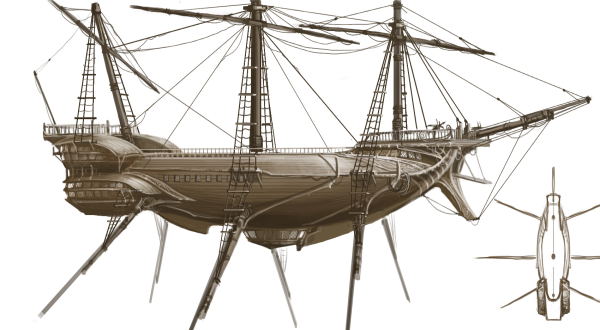
As I pointed out earlier, there are many more skyship designs than the six presented in the previous article. Today I’d like to focus on a Calidaran concept—at least its “alpha” version.  A “beta” will be needed eventually, and you’ll discover why in a moment.  This skyship is not intended to appear in the upcoming book release.

Calidar Bruce Heard Skyship

I present you the Spirit of Osriel. It is the result of an association between a human trader of Lorical and a dwarven engineer who’d emigrated to the merchant republic a few decades ago. Her Grace Felìcita Calitani, a prominent figure at the capital city, sought a vessel relying on winds as its main propulsion, but with a secondary device ensuring safe travel during adverse conditions.  Thus was born the Spirit of Osriel, a steam-powered paddle wheel boat fitted with masts and an enchanted hull to make it airworthy.  Its design flaws soon came to light, the first being the amount of space the dwarven-built engines required, along with their blackstone stores and water tanks.  Freight capacity was therefore reduced accordingly.  Regular supplies of blackstone proved expensive and unpredictable.  With few sails, it couldn’t go as fast as dedicated sailing skyships.  Yet the idea remained attractive.  None of Felìcita’s competitors owned such a vessel, and the ability to reach a destination slowly but safely despite the Great Caldera’s fitful weather became an advantage to her and clients wishing to hire the vessel.  Sails luffing amid the clouds, masts creaking and groaning, funnels spouting sooty billows, and engines thumping faithfully below deck, the Spirit of Osriel specialized in carrying passengers as well as small but precious cargo.

Monday, June 30, 2014

On a Sail and a Prayer

One of Calidar’s objectives is to depict a world whose skies are ruled by flying ships, and whose people yearn to conquer their corner of space.  Naturally, I won’t get into too much detail before the book’s release, but I can give a glimpse of skyship design and styling.

Calidar Bruce Heard Ben Wootten Star Phoenix
Inspired from Earth’s Age of Sail, most human and elven airborne vessels are powered by atmospheric or ethereal wind, at least as regards short distances and battles.  The dwarves of Kragdûr rely instead on pressurized, steam-powered vessels.  On Calidar, the main races live in close proximity to each other.  Some of their skyships combine different technologies relying on wind, magic, and mechanical power.  When space travel is involved, each culture exploits a different technique to overcome the vast distances between their worlds.

Saturday, June 21, 2014

Behind the Maps (Part 3)

I’m pleased to announce that Meryath’s poster map is ready to go to the printer.  This one’s story is as long as the Great Caldera’s (see my previous blog articles).  The two were developed concurrently, as soon as we had a viable coastal outline.  Some of Meryath’s geographical details carried over to the Great Caldera map, while some of latter’s graphic styling, especially the labels’ fonts and color scheme, found its way into Meryath’s poster map after Thorfinn and I settled final cosmetic details.

Calidar Thorfinn Tait Bruce Heard
At a glance, Meryath’s poster map relates directly to Mystara’s Gazetteer maps, although hex symbols were altered to avoid copyright issues.  Our favorite Master Cartographer designed new topographical symbols (hills, mountains, forests, etc) and selected their colors.  I drew the tower, village, and various town symbols, besides generating basic map details.

Friday, June 13, 2014

Happy Birthday, Thorfinn!

Thorfinn Tait Mystara Calidar Cartographer

May fate shower upon you, O Master Cartographer, felicity, good fortune, and endless maps of fantasy!

Monday, June 2, 2014

Behind the Maps (Part 2)

Dealing with Alfdaín presented the challenge of generating Elvish names without sounding too much like a Tolkien-wannabe.  The names used here blend Nordic-sounding syllables, old English/Germanic, and Breton Celtic. I reverted to plain modern English for geographical features, like bays, forests, and mountains.  I may yet invent a new language, as I already did for the dwarves.  Instilling some rhyme and reason to all these fancy words may be just the thing I’ll do when the time comes to focus on Alfdaín (or Alorea).  This parenthetical reference does bring up another issue.  While rereading the manuscript, I noticed a curious discrepancy.  All accents in Alfdaín names rise toward the right. However, there is the Alorean society called Tòrr-Gàrraidh whose accents rise toward the left.  If you’re tending toward OCD, the compulsion is to fix the disturbing detail, immediately nudging all accents to lean the same way.  But no-no-no: any OCD predisposition on my side rests backwards and upside-down (especially on even-numbered days).  I decided that Alorean accents should aim one way and Alfdaín’s the other, if you get my penchant.  The logic behind the offending accents is a form of subtle intellectual mutiny only making sense among elves (and French readers).  Elven grammarians on either side will never agree on which is the right way and, if given the opportunity, will probably come to bold words (no doubt appropriately accented) and italic blows over their diverging linguistic standards.  The dwarves quietly snicker at the oh-so pedantic conflict.  Their accents look like miniature mountains (sans serif), making everyone there ever so smug about their stonelike cultural rectitude.

Calidar Bruce Heard Thorfinn Tait

Tuesday, May 27, 2014

Behind the Maps

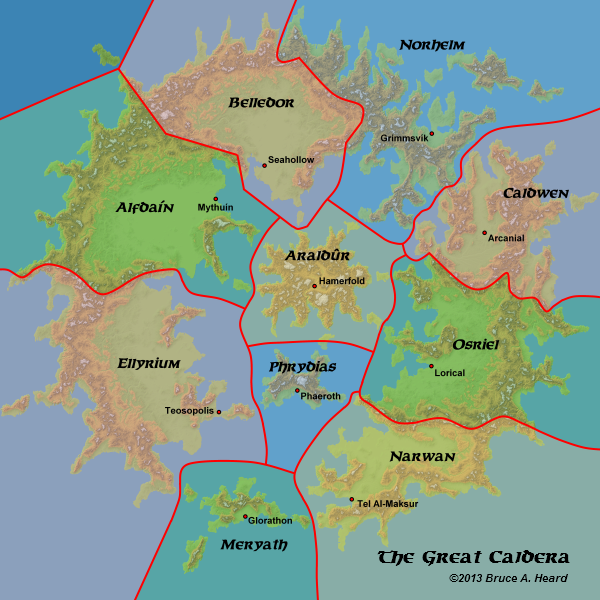
Putting together the main poster map for the World of Calidar has been a major project. On the one hand there was a long learning curve for Thorfinn Tait, the project’s Master Cartographer, to handle the array of software generating the map’s terrain detail, color, and texture. On the other hand, work quality had to be high because this map is the one from which most others will derive. The structure of the Calidar series calls for each book focusing on a particular area of the world, like the original Princess Ark episodes in Dragon Magazine twenty years ago. The starting point is the Great Caldera, Calidar’s “Known World.” It features ten realms, although some of them include vassal powers that could be treated separately. The main source map must therefore be detailed, exciting, and as perfectly rendered as possible for close-up work. Here are a few sample images that will give you an idea of what went into this map.


Saturday, May 10, 2014

Voices of Calidar

I'm about to begin work on map labels for the Great Caldera poster map. The map itself is practically complete, thanks to Thorfinn Tait's tenacious efforts. Coming up with hundreds of unique, cool-sounding, and evocative map labels is usually a thankless, fastidious, if not mind-numbing process. I probably will generate many of the tags myself, but I thought I'd extend an invitation to anyone willing to pitch in. If you're interested, pick one of the realms, as defined below, and organize labels as shown at the end of this message. You can post them as comments here or on the original discussion thread (for the sake of feedback and such). Please don't kill yourself with hundreds of names. Keep your list to a manageable length. There is no guarantee I'll use all your suggestions (or use them without modification), but they will certainly help. I included a few below to give you some ideas of where I'm going with the various nations, etymologically or as far as their approximate ethnic consonances are concerned.

Meryath: all done! (But you already knew that, didn't you?) These are mostly Polynesian in style with Greco-Byzantine influences. :mrgreen:

Ellyrium: pseudo-Greek-Byzantine, with some Romanian influence (more or less in Karameikos style if you will) -- Teosopolis, Teosion, Hadradas, Hurion, Lamazu, Rasku, Arathon, Taitu, Lammathu, Mormion, Bellerion, Antas, Nervion, Gynaion, Arthenion, Trithon, Locathas, Minothas, Aranion, Basilion, Elyrikos, Antiatis, Temenopolis, Thrakesian, Helioklios, Erebos, etc. Many of these came from Meryath's early map and got moved since then to Ellyrium proper. So I do have a head start here.

Friday, April 25, 2014

Of Glantri and Time-Travel

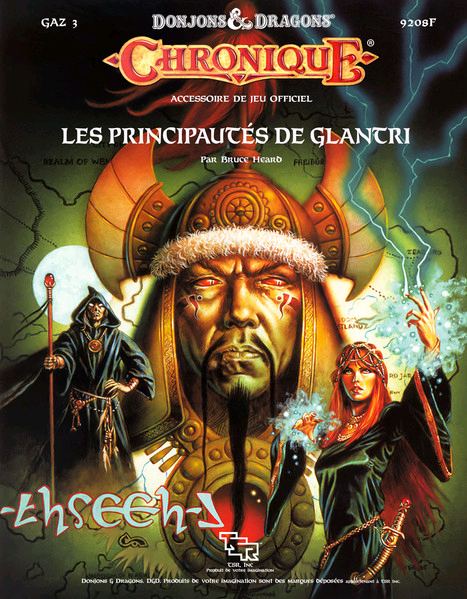
GAZ3 Glantri French Translation
I got a tap on the shoulder yesterday about GAZ3 Principalities of Glantri getting translated into French.  Thanks to the good work of the fans at Donjon du Dragon, the D&D Game fan site east of the Channel, and in particular of the mysterious translator by the name of Squilnozor.  Thank you!  I rushed to peek at the result—a most impressive PDF at first glance, free for registered members.  Nearly thirty years ago, the French market was blessed with official hardcopy translations of the Basic and Expert sets, IIRC, and the first two Gazetteers—barely enough to whet a gamer’s appetite.  Since then, the fans have taken over, filling the gaping void left by TSR.  Seems strangely familiar, doesn’t it?

You might wonder why I post this here, given that the majority of this blog’s readers are English speakers who already have access to the original print or to the PDF recently released by WotC on DTRPG.  It’s a source of nostalgia for me to find both the American and French versions on an equal footing, sort of, at least as far as PDF files are concerned.

I wrote GAZ3 on a freelance basis while employed at TSR.  This meant feverishly designing and giggling maniacally in my office at home, late into the night.  Details of how I generated this much material in a few short months, besides being married and having a full-time job, faded amid the fog of decades past.  I do remember being awfully busy.  All things considered, I also recall some pointed comments from my ex about not paying quite as much attention to her as she felt I should.  In retrospect, she was probably justified.  This in part explains why I didn’t go into turbo mode and write a whole lot more Gazetteers.

Wednesday, April 9, 2014

Calidar Moving Ahead

Calidar John Dollar
Concept work from John Dollar
It's been almost a year since my most-viewed-ever blog post "Bye-Bye Princess Ark" went online.  Since then, a lot has been accomplished.  The Kickstarter succeeded, and the Calidar project is now nearly complete.  I had started with the idea of adopting much of the feel and general themes from Mystara and, more specifically, the Voyages of Princess Ark published in Dragon Magazine back in the 80s and 90s.  I think I have accomplished this goal, without running roughshod over WotC's IPs . . . and then some.  It's very hard to tackle something as deeply ingrained and as much beloved as Mystara, which has benefited over the years from a wide array of published material and fan work.  Where did I start, you might wonder.  Many supporters of the popular game world may look at Calidar with a certain amount of doubt, if not indifference.  However, this new fantasy setting has now developed into something that clearly goes beyond what Mystara accomplished, at least regarding the initial themes and the general scope of the first book, "In Stranger Skies."  The present work certainly exceeds the boundaries reached by the Princess Ark.

So where are we at, as of today?

Sunday, March 30, 2014

GARY CON VI

Gary Con VI
Janet and I had the pleasure of attending this yearly event these past few days. Gary Con is special to me because, of course, it connects directly with Gary Gygax and it is just outside Lake Geneva, but also because many of my friends and colleagues are present as well.  Though it is growing every year, this event has retained a certain friendliness and personality that much larger venues can no longer hope to offer. Where else would you be able to encounter this many former TSR folk without actually trying? The cocktail party Saturday night was a success and new familiar faces were there as well. The high point for me was spending some good time with an old friend whom I hadn't seen for thirty years: Merle Rasmussen, the designer of the original Top Secret game. Merle left TSR in 1984, about a year after I started there. Although he enjoyed a long and fruitful career in his native Iowa (and still does), he connected recently with Jayson Elliott at (new) TSR/Gygax Magazine and Luke Gygax. I was also very pleased to chat with Betty Elmore whom I hadn't seen for almost as long. Many other friendly faces haunted the halls of Geneva Ridge that cold, crisp evening. Sorry I didn't get everybody.  All good times must come to an end, so I'll post my pictures here for your enjoyment . . . and get back to work on my current project.

Gary Con
Dungeoncrawl meets SF


Friday, March 7, 2014

March Update

Ahoy!  Backers of the Star Phoenix!

As of early March, the Calidar project is proceeding apace.

Since last February, the first 63 pages have already gone through the editing process with Karen S. Conlin. This includes the main story, "In Stranger Skies," the overview of Calidar's universe (the planets, the moons, the races, and the gods), and the world of Calidar (the continents, the world soul, the Dread Lands, the Great Caldera, an overview of the realms, and a detailed historical timeline).

Meanwhile, writing continued for the Kingdom of Meryath gazetteer: its history, geography, economy, diplomacy, armies, internal politics, the culture of heroes, calendar, holidays, the NPC section (Heroes of the Star Phoenix and Heroes of Meryath), and the Guilds and Brotherhoods section.

Friday, February 28, 2014

Aaron Allston

I'm very sad to learn about Aaron Allton's passing, yesterday, February 27th.  Aaron was a long-time and trusted contributor to the Mystara product line as well as the author of many other works.  I'd like to take a moment to salute his achievements.

Game Titles

Hero Games
     Blood and Dr. McQuark, The
     Champions (5th Edition)

Monday, February 10, 2014

Calidar Status Check

Story "In Stranger Skies" is with the editor.  She says she's enjoying Mama Goo's linguistic peculiarities.

"Mama Goo, she speaka like de fellfolk.  Mama Goo, she cut off de chicken 'ead an' read de blood.  Now she know de Great Spirit put Mama Goo on de big canoe in de sky. But de Great Spirit, she no' say why.  An' Mama Goo, now she like de lilla' cap'n.  Him great warrior."    

Done writing the world and races overview.  Honestly, it would help if the book were at least twice the intended size.  So much to say, so little space. . .

Almost done with Gods, Gate Keeper, and World Soul.  Don't ask.  I'm not telling what this really is until the book comes out.  Patience, grasshopper.

Art Order for internal illos is with John Dollar
Ben Wootten is working on cover art sketches
Ed Greenwood is working on the City of Glorathon

Thorfinn Tait is plugging ahead on cartography (I'm jumping up and down until he sends me new updates).

Tomorrow: Lego Game movie break (though I'll be still working from 06:00 until noon)

Day After: start with Chapter 3 -- Planet Calidar Overview (History, Geography, Secrets of Calidar such as Seitha, Dread Lands, etc.)  All this stuff is probably headed to the editor ahead of schedule.


Proceeding at about 1,500 to 2,000 words a day.  It's crazy cold outside.  Maybe that's a good thing.

Monday, January 27, 2014

Preview: The Soltan Ephemeris

The World of Calidar as presented in the first book, "In Stranger Skies", depicts a star system somewhat similar to our Solar System. The sun is called Soltan. The heroes' planet is Calidar, which possesses three moons, two orbiting on the same path (Alorea and Kragdûr), on opposite sides of Calidar, and the third further out (Manaan).

Two other planets exist nearby—Draconia, closest to Soltan, and a red world, Lao Kwei. The latter has a moon called Kumoshima. Based on their names, I’m sure you can figure out the general nature of these settings. Beyond Lao Kwei lies the Fringe, a ring shaped collection of dwarf planets and asteroids. It is a cosmic frontier with all sorts of hidden worlds gravitating alone or in clusters. An extra planet, Ghüle, also orbits through the Soltan Ephemeris. My previous post describes this most peculiar world.

Having listed these asters, the issue of travel time quickly comes up in a world where space-faring skyships are the norm. I’ll skip the "how" because this is a chapter of its own which will be featured in the upcoming book. This preview provides a few other things, such as the illustrations above and below and a calculator to plot the positions of planets based on a calendar date. I decided to tackle this topic since the Star Phoenix’s story lists dated log entries, which means I can’t just "fudge" travel times.

The diagram above shows the approximate orbits of planets. The diagram on the left shows the relative sizes of the worlds.  The hex grid helps estimate travel times. Using the various magical techniques available in that universe, the fastest travel speed between planets amounts to five days per hex. From a mother world to a nearby moon takes approximately 15 hours, or in the case of Manaan 20 hours.

Several points are marked on the first diagram, as follows:
A: Ghüle has now thawed enough for orcs to be able to reach the surface of their world. No raiding happens as of yet.
B: Ghülean orcs may begin raiding if Lao Kwei is in range
C: Ghülean orcs may begin raiding if Calidar is in range
D: Window of opportunity to raid Calidar ends
E: Window of opportunity to raid Lao Kwei ends, however the Fringe is now within raiding range
F: Window of opportunity to raid the Fringe ends
G: Ghüle has frozen over and will remain locked beneath ice for the remainder of its orbit
Because of the difference in orbital speeds, Ghüle’s raiding season on Lao Kwei can only last at most 24 days. Raiding season for Calidar can last, however, as much as 45 days!

The trick is that planets move while skyships travel. Likewise, the actual position of a world on its orbit path at a given date makes a huge difference. I posted a calculator to help figure out where planets are.  It is located at the end of this article because of formatting issues I've been unable to solve.  All you need to do is enter an actual date. The calculator is set up with the 3rd of Loreath 1512 (the fall equinox in Calidar’s northern hemisphere) as its default "start date." Entering a different date will show where the planets move to. Positions are expressed in hours and minutes, as if Soltan were the center of a clock, twelve o’clock being "north" on the diagram, six o’clock "south." This provides a quick and simple way to locate the planets and measure the distances between them.

Thursday, January 16, 2014

Sneak Preview: the Orcs of Ghüle

Like any heroic fantasy setting worth its salt, Calidar is host to many bogeymen of its own. The orcs clearly stand among them. Although they exist on this world, orcs, goblins, trolls, ogres and many other related creatures aren’t natives of Calidar’s universe. Neither are they true space-faring races. Instead, these creatures hail from another reality, one ruled by evil, voracious gods whom they serve. Though orc flesh occasionally furnishes adequate sustenance, these alien divinities crave another. Man flesh is sweeter and far more pleasing, while elves and gnomes provide the greatest of delicacies. Curiously and inexplicably, fellfolk lie on the opposite end of the edible spectrum, those of Calidar’s Dread Lands tasting the vilest. Though marginally more palatable than orcs, dwarves are favored as working slaves. Epic heroes, mighty monarchs, demigods, and legendary creatures of goodness are all highly sought-after prizes, well worth the terrible cost of capturing alive.

With this in mind, these gods have built several worlds over the course of millennia, planet-sized spheres of rock imbued with air, water, and self-sustaining life, engineered as colossal dungeons. Anywhere from hundreds of thousands to millions of their servants now live within these worlds, which are intended to travel other universes and return to their home plane periodically. Their purpose is to fetch all that their gods demand, live food, slaves, treasures, and magic. Success enables these wayward humanoid realms to escape their gods’ voracity, thereby conferring them the morbid determination to continually seek out and pillage other planets.

Friday, January 10, 2014

Calidar Fireworks!

Wow!  We did good with The World of Calidar's Kickstarter.  We topped $19,000 funding or more than 300% of the initial goal.  What a thrill.  There are still a couple of hours before the official end of the crowd funding session (10:00 am US Central time) to adjust your pledges and secure that extra Gazetteer map, or jump in if you haven't yet.  Contact me if you missed the boat but would still like to be involved.  Happy cheers & thanks to all!

Click here for the Kickstarter event


Saturday, November 30, 2013

Bumblebee Part IV

This section is Part IV of Flight of the Bumblebee, originally run at the Lucca Games 2013 convention. It provides a summary of game statistics and other handouts. Click here for Part III, Shadowfall Manor. Give the players the pre-generated character sheets and the Bumblebee map and key, and start having fun, already!

H.H.M.S. Bumblebee

The Bumblebee is a skyship bearing three sets of masts standing in a star-shaped configuration (60 degrees from each other—three masts upright, three on the lower starboard side, and three on the lower port side), for a total of 9 masts, plus one bowsprit. The three lower starboard and lower port masts can be accessed through hatches. An enchantment on the ship's decks enable artificial gravity on the horizontal plane. A sphere extends just outside the edges of the masts which provides life support for high-altitude flights or travel through space. The hull and the ship’s main structure radiate levitation enchantment providing basic lift, which can be controlled by the helmsman. Actual maneuvering comes from a separate device inside the skyship (lower deck area 1), also controlled by the helmsman. The Bumblebee has five decks:
  • Quarterdeck
  • Upper Deck (incl. the forecastle and the stern deck)
  • Main Deck
  • Lower Deck
  • Ship’s Hold

H.H.M.S. Bumblebee: AC7, HP120, MV 120’/round or 72 miles/day, #AT see below. Due to crew limitations only two main deck weapons can be used simultaneously, or three ballistae; boltmen are not trained on these weapons. Crew: 1 captain, 10 boltmen, 20 sailors. Special Abilities: can sail at double speed for one game turn, once per day. Armament:
  • 6 ballistae: AC4, HP9, #AT 1/2, Dmg 1d10+6, Range 100’/200’/300’
  • 4 light catapult (2 each, starboard & port): AC6, HP18, #AT 1/5, Dmg 1d8+8, Range 200’/250’/300’ min 150’
  • 1 heavy catapult (aft): AC8, HP 27, #AT 1/6, Dmg 1d10+10, Range 250’/325’/400’ min 175’

The Bumblebee Map Key

Wednesday, November 20, 2013

Shadowfall Manor

This adventure is Part III of Flight of the Bumblebee, originally run at the Lucca Games 2013 convention. Click here for Part II, Windstone Tower.  Give the players the handouts showing outside views of the manor, and read them the text printed in brown.

From the Outside: Shadowfall is of a square design, 50’x50’ at the base, with a tower dominating its northeastern corner. A six-foot-tall outside wall featuring an ornate wrought-iron gate encloses the domain. On the house’s north side lies a small cemetery. The surrounding yard looks somewhat neglected, with weeds overgrowing what once was an elegant garden with topiaries and flowerbeds. A small statue smudged with bird droppings stands in a pool now filled with dead leaves. A gravel path leads from the gate to a set of double doors in the manor’s southeastern corner; a wooden awning keeps in the shadows an open gallery just above. A terrace on the third floor partially surrounds the tower. Judging from the windows, the gray and black, Gothic-style manor stands six levels high, including a peaked roof on the tower. All windows are heavily barred. Heavy in the day’s gloom, clouds run steadily to the south, chased by the hills’ cold bluster. A murder of crows caw in the distance.


The manor’s walls are built mostly of stone, while floors and roofs are made of wood. A chimney conduit near the N-E. corner leads from the ground floor to the tower’s roof. A creature the size of a cat could get through this opening. Unless listed otherwise, window panes are colored and hard to see through from the outside. Windows can be opened from the inside. Most rooms have one or more windows. For simplicity, they will not be mentioned in the individual room descriptions that follow, unless players ask about them. Levitating incorporeal spheres provide a faint and sallow lighting in windowless rooms. There are no mirrors in the house. Secret doors reset themselves within a few rounds of being opened. A bell from a grandfather clock somewhere in the manor tolls every hour.

Wednesday, November 13, 2013

Windstone Tower

This adventure is Part II of Flight of the Bumblebee, originally run at the Lucca Games 2013 convention

Map Key: Windstone Tower sits on a small cloudstone island, at about 10,000 feet altitude above the town of Ailpon in Floating Ar. Clouds mask the island’s approach and give the site a forlorn appearance. A large boom and gangway extending from the island’s rocky base provide mooring to visiting skyships. Based on the position of windows, the blue-gray tower stands five levels high (including an open-air level on top), about 50’ in diameter. All windows are heavily barred.

Lucca Games 2013
The tower is made of levitating cloudstone. Unless indicated otherwise, incorporeal spheres provide lighting in all rooms. Secret doors reset themselves within a few rounds. All "pie-shaped" chambers larger than 10’x10’ (except for the Main Hall) have one window centered on their outside walls. Glass panes are colored and hard to see though from the outside. Windows can be opened from the inside. If the party circles around the tower, they will find a dead Heldannic Knight lying on the rock. His armor and helmet are slightly crumpled, and blood has poured from his nose and ears. Closer examination should reveal his cranium was badly fractured (he was a victim of the trap in Area 9).

Thursday, November 7, 2013

Flight of the Bumblebee

Bruce Heard—Lucca Game Fair 2013, Part One of Four.

H.H.M.S. Bumblebee is the party’s skyship, a vessel recently purchased by King Qissling of Floating Ar for his air fleet. Pre-generated characters are randomly distributed to the players, along with player handouts depicting the skyship’s deck plan and key. Player characters should be top-ranking officers: Captain, First Mate, Master, Captain-at-Arms, Master Artificer, Master of Engines, etc. Include the Purser in the initial party to make sure a character with thieving ability is available. Additional NPCs can replace eliminated PCs. The adventure is intended for a party of 5-7 adventurers, levels 7-9.

Plot Setup


To the players: You are skyship officers in Floating Ar’s air fleet, currently assigned to the H.H.M.S. Bumblebee. Your standing orders are to patrol the skies of Floating Ar for smugglers and other intruders, and actively pursue them. Your vessel is presently moored in Skyreach, awaiting resupply.

To the Captain and First Mate: You have been invited to a reception at Prince Qirklin’s residence. You know he was an illustrious peer of yours from your time at the Skyship Academy, so you do trust him. While you attended the reception, the prince spoke to you privately, asking for a favor, one with a good reward for all among the crew and officers of the Bumblebee. He requested your ship quietly make for the floating isle of Windstone, just a few hours away. Your secret mission is to secure its owner, Belsaphet the Sage, as well as a magical mortar carved out of malachite and a large silver flagon full of a refined oil bearing strange properties. All must be brought to Skyreach as soon as possible as treachery may be in the works. The sage’s research is critical to the kingdom’s security. Should the sage meet an untimely end, his complete remains must be brought back as well so he may be revived to continue his work. The mission is secret but should not interfere with the Bumblebee’s current standing orders.

Plot Overview

Prologue: By the time the party reaches Windstone Tower, the Heldannic warbird Talons of Faith hides in a bank of clouds, waiting fort the Bumblebee’s crew to explore the tower. The knights will ambush the party’s ship when she attempts to set sail from the tower.


Windstone Tower: Heldannic Knights already stole the malachite mortar and decapitated Belsaphet. The oil is still hidden in secret vault with a few other valuables, which the party may, or may not discover at this time. If questioned, the sage’s raven companion, Nevermore, will reveal clues about who committed the crimes: Craak! Men on a big eagle in the clouds killed Master. Took Master’s head. . . took Master’s head. It agrees to join the party—useful since it can talk to other birds in the area which will help the party track the escaped skyship (there are plenty of other ravens, hawks, seagulls, and geese to be found if one looks for the knights). If the game bogs down, Nevermore can help get the party going in the right direction.

Mystara Heldannic Knights Warbird
Ambush: Soon after the Bumblebee’s departure from Windstone Tower or as the crew attempts to set sail, the Talons of Faith ambushes the party. After a short aerial battle, the knights board the Bumblebee and fight to the death. The knights will try to make a run below deck. While some stay behind to block access to the companionways, the others seek to destroy the Bumblebee’s steering mechanism, after which they will look for the silver flagon in the captain’s quarters. If the party gains the upper hand during the battle, the knights’ commander retreats to his quarters and sends a message to the Heldannic Order’s high priest. When the party finds him, he burns his magical communication scroll, seizes his sword, and fights his ultimate fight.

Wednesday, October 30, 2013

A Calidaran Halloween


As I suspected, the bloglist did not update to show my latest post.  If you see this one, be afraid--be very afraid-- for it's Halloween after all.  Also, click on this link to access my big announcement regarding the World of Calidar project.

And Happy Halloween to you all!

Friday, October 25, 2013

Bye-Bye Princess Ark. . . Hello Calidar!

Dear Readers,

Now that the project is well under way, I believe time has come to say more about the World of Calidar and who is part of the creative team.

As I'd pointed out earlier, this fantasy setting is entirely new and does not rely on any specific game system.  Calidar emphasizes skyship adventures.  The final product is intended to include a gazetteer and a poster map.  Written materials should amount to at least 80,000 words, of which 60% will be a story unveiling the adventures of the Star Phoenix and her crew under Captain Isledemer d'Alberran's command.  The latter are inspired from the Princess Ark episodes published in Dragon Magazine twenty years ago.  Though the ship, her crew, and their strange new world are different from those of the original series, the analogy remains intact in style and spirit.  The campaign set (color) will be available both as an e-product and in print.  Because of print-on-demand limitations, the poster map will be offered separately and in print only.


Calidar Stranger Skies Bruce Heard


A Few Words About Calidar

The vast majority of its population came from three lunar empires—the humans from Manaan, the elves from Alorea, and the dwarves as well as their gnomish cousins from Kragdûr. The fellfolk, a race of small but fierce people, are the planet's original inhabitants. Calidar is imbued with a feral magic hostile to the expansion of civilization, a dangerous world only partially settled by the three outer world empires.  A central region called the Great Caldera, a three-thousand-mile-large crater partially filled with an inner sea and ringed with towering mountains, serves as the cradle of civilization. There, the empires overcame nature’s ferocity and established sprawling colonies. But over time, they rebelled and, after a long period of conflict known as the Sky Wars, the new realms earned their independence from the overlords. A fragile truce now remains between the three empires and their former colonies.  Beyond the Great Caldera lies what is known as the Dread Lands.

The truth is that two lunar empires are overpopulated and exceeding their natural resources. The other, more attuned to nature, now stagnates, unwilling to further harm its own world. It was the reason for the rush to establish colonies on Calidar. There was, and still is, another reason. Traveling the immense distances between Calidar and its moons, and reaching other worlds gravitating around the Great Soltan is only possible with a certain type of magic. At the heart of imperial rivalries lies a strange substance called Seitha, which enables skyships to become incorporeal and travel at fantastic speeds. Though it can be found on the moons, the existence of the precious Seitha has been declining there since its discovery. The Dread Lands now remain its principal source and the origin of many conflicts to obtain it.

The appearance of the substance in Calidar’s soil is predicated upon the health of that world and its moons. It is believed that all magic comes from the beating heart of Calidar, tying together not only Seitha but the souls of the dead and the very lifeforce of all that dwells on its surface, in the skies, and beyond—be it flora, fauna, or sentient kind. It is strong enough to enable gods to spring from the inhabitants’ spiritual beliefs. Indeed, Calidar is unique in that the divine did not create this universe and its people. It is quite the opposite. To each world its own gods, demi-gods, epic heroes, and demons competing to retain the favors of mortals who created them, and to sway the minds of others for the sake of eternal hegemony. . . or oblivion.

A Glimpse at the Skyships

Airships of Calidar are as varied as its people, whether spacefaring or not. Let’s start from the ground up: with the dwarves of Kragdûr. These fellows aren’t wizards, yet they build flying ships. Theirs are brutes of steel, fire, and brimstone. In keeping with their own love of things from the ground, dwarves fly powerful dreadnoughts whose hulls and superstructures are made of forged iron, steel, brass, and copper held together with rivets.  Cannons are their weapons of choice. They use coal and special minerals found on their moon, providing lift and thrust enough to propel their massive beasts. Kragdûr dwarves favor a harsh warrior-like culture.

Elven designs depart radically from the dwarven paradigm. Alorean vessels look more like sail ships from the Golden Age of Clippers. These are wind-powered, quad-masted, wooden vessels built for speed. Their style and workmanship remain unmistakably elven, with a heavy emphasis on organic rather than functional. Up close, their artful designs are reminiscent of twisting roots and leaf patterns. Unlike vessels of other races, Alorean liners house extensive hydroponic facilities within their hulls. Alive, self-healing, and able to grow parts like davits, boarding planks, hammocks, and tether-roots, they also feature deck weaponry in the form of native Alorean plants living in symbiosis with the ships. These elves behave more like artful intellectuals.

Human-built skyships of Manaan are far more varied than elven or dwarven designs. They stand anywhere between the two extremes of demi-human ships, blending metal and wood in various proportions. Manaani commanders generally favor maneuverability over speed or strength, which implies a preference for galley designs. Style-wise, they depend on the region of origin, somewhat like real-world 16th Century galleasses and 17th Century galleons that can be fitted with auxiliary oars. This implies an inverted tri-mast design (two sets of upper masts angled in a V-shape and one set of vertical masts underneath the hull) to allow clearance for the banks of oars. They usually rely on combinations of magic and mechanical devices as main deck weapons. The Manaani are highly religious people, for better or for worse.

And what of native Calidar vessels, you might wonder?  These ships are even more unpredictable as they mix and match designs from either of the three moons, making foreign observers cringe at certain very, very odd concepts. This habit goes back to the time when colonies broke away from their outer world overseers, and had to use whatever they could seize in combat or recover from wrecks. Anything goes, merrily blending dirigibles, wind sails, steam-powered paddle-wheels, mixed-dwarven and -elven medieval wood-and-steel bio-mechanics, ethereal ley line nets, four-winged flying beasts, and so on.
There’s more. . . how about the scaly, acid-spewing, glistening vessels of the evil Draconnic Knights? Giant flying junks and armored turtle-ships claim the skies in faraway Lao-Kwei. At last, let’s not forget the space Vikings with double- or triple-deck longships feared by all, including the mysterious starfolk.

The Master Puppeteers

Before proceeding further, I would be remiss not to introduce the talent behind this project. I’ll skip the writing part since you all know where it comes from. Instrumental in capturing the physical appearance of Calidar, Thorfinn Tait, from Akita, Japan, stepped forward months ago to handle the world's cartography.  Thorfinn is best known for his work on Mystara maps during the past twenty years.  From the onset, he and I worked to fit Calidar’s continents around a globe, ensuring an accurate and very recognizable depiction. Ben Wootten, a concept artist and illustrator from Wellington, New Zealand, will paint the cover art.  His portfolio includes design work for the Lord of Rings movies as well as art for Wizards of the Coast and Pathfinder among many others. His incredible appreciation for nature is evident in the creatures he draws, both real and imagined.  [EDIT -- 12/03/2013]  John Dollar  will be producing pencil and ink illustrations. His extensive artistic background includes TSR's Ravenloft, Birthright, and Dark Sun, as well as FASA, White Wolf, and West End. He also worked on Shadowhunters Codex by Simon & Schuster, Earthdawn, Star Wars, Tales of the Emerald Serpent, and Larry Elmore's Sovereign Stone.  Last but not least, my good friend from Toronto, Canada, Ed Greenwood, creator of the Forgotten Realms and author of many related novels as well as a Mystara Gazetteer, has also kindly offered his time and talent to write additional material.

What Next?

With great talent comes great. . . never mind. Putting a product out on the market demands proper funding. As a result, a Kickstarter campaign is necessary to cover production costs. I am therefore asking all of you how excited you are about the World of Calidar. I posted a tentative outline for the campaign’s pledge levels below. From the surveys listed near the top of this page, select the pledge level and add-ons you feel comfortable backing. This is for information only. The first survey concerns pledge levels. The next one deals specifically with multiple-choice add-ons.

Edit Dec 06 2013: the survey is now closed.  Thank you all for your participation.  Results indicate enough backers for at least basic funding, provided everyone shows up.  Onward!

The Kickstarter campaign is likely to last thirty days from early- or mid-December into January 2014. Your comments are welcome, either on this thread or to bruceheard@worldofcalidar.com privately. Be fair, be honest, and above all, be realistic. Because this is my first Kickstarter, this survey helps me get a better idea of how many of you feel strongly enough about this project to back it personally. Your responses will drive budgeting and whether the project will succeed at all.

Ideally, the ultimate target is a product the caliber of a D&D Gazetteer—I’m sure most of you know what I mean. If pledges go beyond basic funding, then additional text, maps, and art should be forthcoming. Multiple projects in a single year also become possible with stretch goals. Bear in mind that the World of Calidar is a series of products, not just one single release. That’s all up to you.

Pledges
Name Reward
$5
Airman PDF of the Calidar Story + Access to the cliffhanger episode
$10
Bosun As Airman + PDF of the World Supplement
$25
Master As Bosun + Softbound booklet + Your name in the Honor Roll
$35
First Mate As Master + Poster Map
$50
Captain As First Mate with booklet upgraded to Hard Cover premium color format
$250
Admiral As Captain + autograph + Name an Island + Cloth Map + Bookmark
$75
Innkeeper Advertizing included in the e-product (PDF of the Story & World Supplement provided; Businesses only, two slots)
$200
Outfitter Advertizing included in both printed and e-products (Softbound booklet provided; Businesses only, one slot)
Add-Ons (at First Mate Level and above)
$75
Add-on #1 Your character name included as cameo appearance in the story (20 slots only)
$75
Add-on #2 Name a skyship in the story or world supplement (20 slots only)
$25
Add-on #3 Free download of Hexographer Pro presently valued at $31.95
 $8
Add-on #4 Additional copy/copies of the Poster Map

The Calidar Story: "In Stranger Skies" is the first part of the booklet—the story of how the Star Phoenix and her crew enter the Calidar universe.

Cliffhanger Episode: while the Kickstarter takes place, I’ll be posting short stories on this blog and elsewhere to promote the project. The last one of these episodes should appear directly on the Kickstarter backers' page.

World Supplement: this is the second part of the booklet, which describes the setting, much like a game supplement would, with historical facts, geography, realms, unique features of the universe, major characters, the main faiths, plot devices, monsters, etc.

Softbound/Hardbound Booklet: there will be two versions of the booklet—softbound and hard cover. Both are color, but the hardbound has much better paper and printing which is especially relevant to the quality of internal color maps. So far, the plan is to offer these booklets either via DriveTru RPG or CreateSpace (to be determined).

Honor Roll: the list of backers at Master level and above appears inside the booklet.

Wednesday, October 23, 2013

My Schedule at Lucca Games

If you plan on connecting with me at the convention, here is my daily schedule. The convention is located in the beautiful old town of Lucca in Italy.  The high points of my participation include the opening of the TSR Showcase, a world-building seminar, and two game sessions I'll be DMing.  The adventure is designed for Expert-Level D&D and involves (you guessed it) skyships.  It starts off in the Kingdom of Ar and, if the players can solve the first part of the adventure fast enough, to a Principality of Glantri (I'm not saying which).  I believe there is more than can be played in three hours, so it'll be more about how far players get than whether the final goal is actually reached.  For those of you who will not have the opportunity to participate, fret not, for I shall post the adventure, complete with maps and pre-generated characters, right here on this blog, after I return.  The seminar also includes a Q&A session during which, if the opportunity presents itself, I'll gleefully talk about the new project, the World of Calidar.